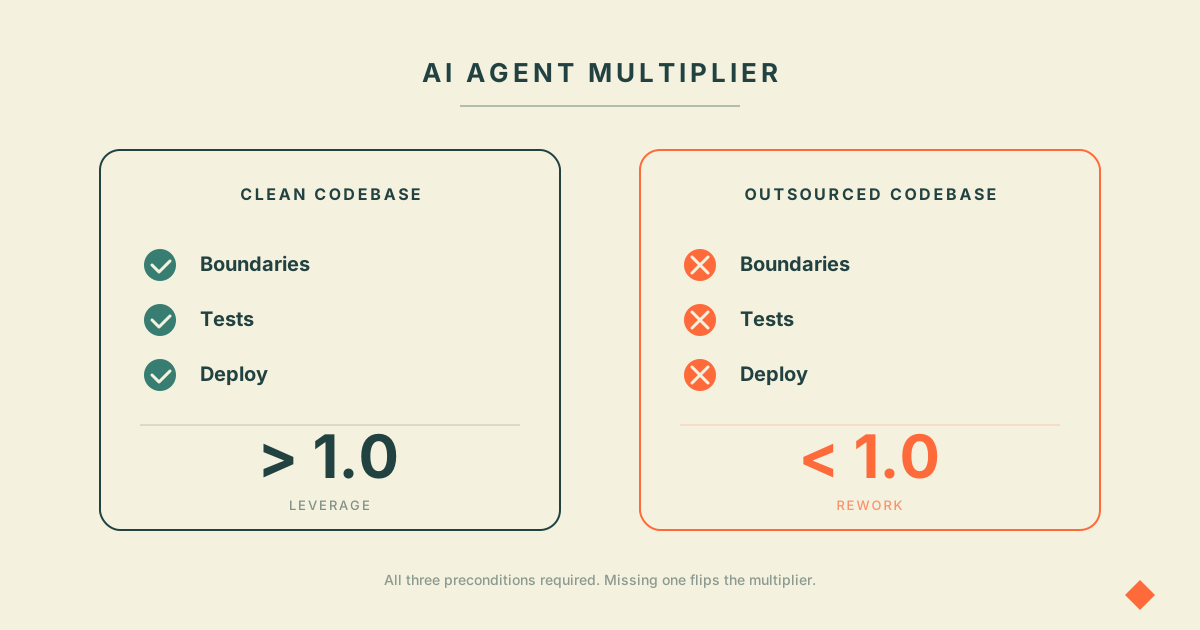
AI coding agents are multipliers — they only return positive ROI when three preconditions are in place: clear architecture boundaries enforced in CI, tests that catch real bugs, and on-demand deployment. Typical outsourced codebases score poorly on all three because the contract pays for tickets, not codebase ownership — so every dollar of AI budget produces more rework than delivery.
Most founders I talk to assume the same thing: their outsourced engineering team can plug AI into their workflow and get the productivity gains they're reading about on LinkedIn. The math doesn't work that way.
AI agents are multipliers. They take whatever your codebase already produces and amplify it. On a clean codebase, that's leverage. On a typical outsourced codebase, it's louder failure — faster, with the same defect rate and a growing rework backlog.
This is the part that doesn't show up on the Copilot pricing page: AI ROI has preconditions. If your codebase doesn't meet them, every dollar you spend on agents produces more rework than delivery. The vendor adds the licenses, the dashboards look busy, and your effective velocity goes down.
This post is the founder-shaped version of a thesis we've covered for engineering audiences in AI Agents Are Pattern Amplifiers: your codebase determines whether AI helps or hurts. What it means for the typical outsourced setup is bleak — and the gap between AI-native shops and outsourced ones widens every quarter you wait.
The Precondition Most Founders Don't Know About
AI agents work the way a junior contractor with infinite patience works. Drop them into a project, they read the code that's there, infer the patterns, and produce more of it. Faster. They don't push back on bad architecture. They don't refactor the mess they inherit. They mirror.
For that mirror to be useful instead of dangerous, the codebase has to give the agent three things:
- Clear architecture boundaries — the agent has to know where new code belongs. If the codebase has god classes and circular dependencies, the agent picks the same dumping grounds your team has been using.
- Tests that catch real bugs — the agent has to know when it has broken something. Coverage that passes whether the code works or not (what we call decorative tests) gives the agent a green light on broken code.
- A deployable state — the agent has to be able to ship its work and learn from production. If your release cycle is "Tuesday after standup, with a change ticket," the agent never closes the loop.
Miss any one of these and the multiplier inverts. The agent ships faster, but each ship adds rework. The team spends more time on cleanup than the agent saved on production.
Three foundations. All three required. There is no AI tool you can buy that compensates for missing one.
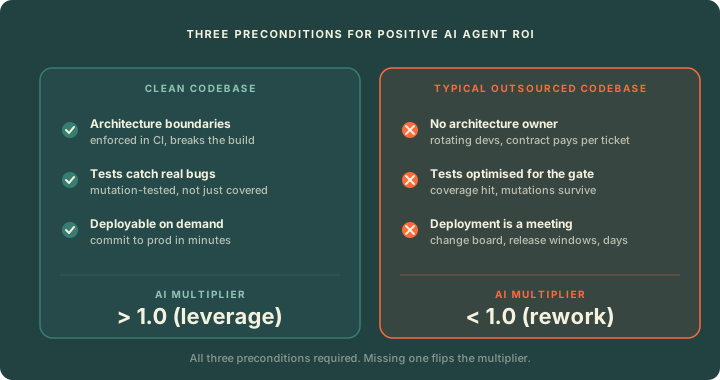
Figure 1: The three preconditions for AI agent ROI — and where typical outsourced codebases fall short.
Why Outsourced Codebases Score Lowest on All Three
This is not about vendor competence. The smartest engineers in the world, dropped into the typical outsourced delivery model, would produce the same shape of codebase. The structure of the contract makes it inevitable.
No one owns architecture. Outsourced teams rotate. Developers leave the project after 3–9 months. There is no resident architect because there is no resident anyone — the contract pays for tickets, not for the codebase. Boundaries erode at the rate of new tickets, and there is no role accountable for refactoring the mess back together.
Tests get optimised for the gate, not the bug. When a vendor reports test coverage to a non-technical client, coverage is the deliverable. The fastest way to hit "80% coverage" is to write tests that exercise the code without asserting much about it. Run mutation testing on a typical outsourced codebase and you will find the suite would still pass even if you deleted the production code it claims to test. The agent gets green on broken code and ships it — and CodeRabbit's analysis of GitHub pull requests already shows AI-authored code carries 1.7x more issues than human-authored code overall. The typical outsourced codebase is the worst-case substrate for that ratio.
Deployment is a meeting, not a pipeline. Most outsourced engagements ship through change boards, off-hours release windows, or ops-team handoffs that take days. The agent cannot close the loop in any reasonable time, so it cannot learn from production failures, and the team cannot test small changes safely. Every release is a batch, every batch hides defects, and the rework backlog grows.
The compounding part is brutal. Each sprint adds another layer of patterns the next sprint inherits. Vendors do not refactor work they did not write. GitClear's analysis of AI-era codebases captures the trajectory in two numbers: refactoring activity dropped from 25% of changed lines in 2021 to under 10% in 2024, while code cloning rose from 8.3% to 12.3%. Teams are adding to code, not reshaping it — and that drift is steeper inside an outsourced contract than outside one. After eighteen months you have a codebase whose preconditions for AI are worse than they were at quarter one. And now you have added agents to the mix.
What This Means for Your AI Spend
Here is the part most founders do not model. AI agent costs do not scale with output — they scale with attempts. Every prompt, every retry, every regenerated test costs the same whether the code ships or gets thrown away. On a clean codebase the throw-away rate is low. On the typical outsourced codebase it is high enough that you are paying for inference cycles that produce net negative work.
And the gap widens every quarter:
- AI tools improve. Each quarter, the agents get better at compounding the advantage of clean codebases — bigger context windows, better test generation, longer planning horizons. The ROI curve on clean codebases bends up.
- Outsourced codebases drift further. Without an architecture owner, every sprint adds entropy. The ROI curve on the typical outsourced codebase bends down.
- AI-native competitors compound. Three engineers with disciplined AI tooling now ship faster than fifteen-person outsourced teams (the math we ran here). They lap you on lead time, deployment frequency, and change failure rate every quarter you wait.
You are not paying a flat price for the same product the AI-native shop is buying. You are paying a higher price for a product that delivers negative leverage.
A Founder's Diagnostic — Five Questions to Ask Your Vendor This Week
These are the questions we walk through with founders during engineering health diagnoses — scoped so you do not need to be technical to ask them. You do need the answers in writing.
- "What is our mutation testing score on the modules we have changed in the last 60 days?" A real answer is a number. "We use code coverage instead" means there is no signal that the tests actually catch bugs.
- "How many automated architecture rules break the build today?" A real answer is a list. "We do not enforce architecture in CI" means there are no boundaries — the agent is free to scatter code anywhere.
- "How long from code commit to production for a one-line typo fix?" A real answer is in minutes. Anything in days means there is no deployable state, and the agent cannot close its feedback loop.
- "Show me the five most-changed files this quarter and the rework rate on each." A real answer is data. "We do not track rework" means defects and debt are invisible — and an AI accelerator on top of invisible problems is not a good idea.
- "Which AI tools have your developers shipped code from in the last 30 days?" If the answer is anything other than "none, because we have not met your AI-readiness preconditions yet," and the previous four answers were weak, you have already paid the amplification tax. Find out where it landed.
If your vendor cannot answer four out of five with data, you have your diagnosis. The conversation is not "are we using AI well?" — it is "should we be using AI on this codebase at all yet?"
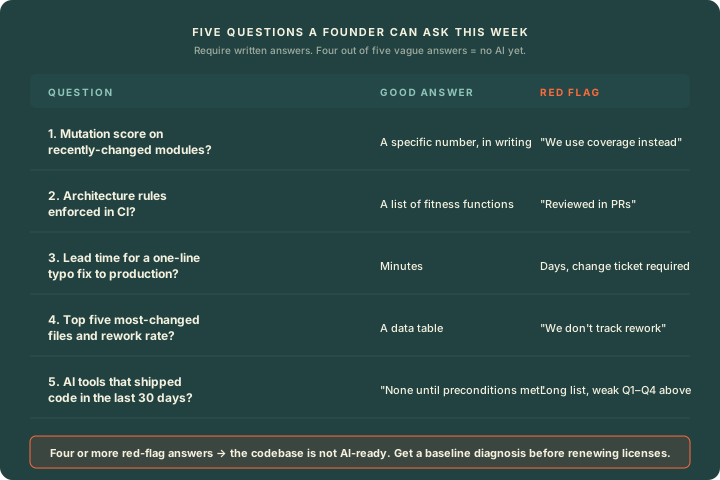
Figure 2: A founder's five-question diagnostic — what a good answer looks like, and what counts as a red flag.
What to Do This Quarter (You Don't Have to Migrate Today)
When we work with founders sitting in this exact spot, three moves come up every time. None of them require burning down the existing engagement, and you can sequence them inside thirty days.
Stop adding fuel. If you are paying for agent licenses on the outsourced team's seats, pause them until the preconditions are met. Counterintuitive — but if the codebase is in the negative-multiplier zone, every additional license is paid permission to ship more rework.
Carve a reference module. Pick the smallest piece of new functionality on your roadmap. Build it as a bounded, clean-architecture, characterised module — either with a small in-house pair or a specialist contractor — and use it as the pilot for what AI-native delivery looks like on your product. You are not migrating the codebase. You are building a comparison.
Get a baseline diagnosis. You cannot argue cost without numbers. Run a code health, DORA, and AI readiness baseline on the existing codebase. The output is not a verdict — it is the data you need to have a real conversation with the vendor (or with your board) about which model your engineering money should be funding next quarter.
This is not anti-vendor and it is not anti-outsourcing. Plenty of vendors run disciplined codebases. The question is whether yours does — and whether the agents you are paying for are landing on a substrate that can amplify them, or one that is amplifying the wrong things.
The Bottom Line
AI agents multiply whatever your codebase produces. Multiply zero, get zero. Multiply rework, get more rework. The typical outsourced codebase scores poorly on all three preconditions for AI ROI — clear boundaries, real tests, on-demand deployment — and the structure of the engagement makes it worse over time, not better. Every quarter you spend AI dollars on the wrong substrate, the gap to AI-native competitors compounds. The fix is not more AI. It is preconditions.


