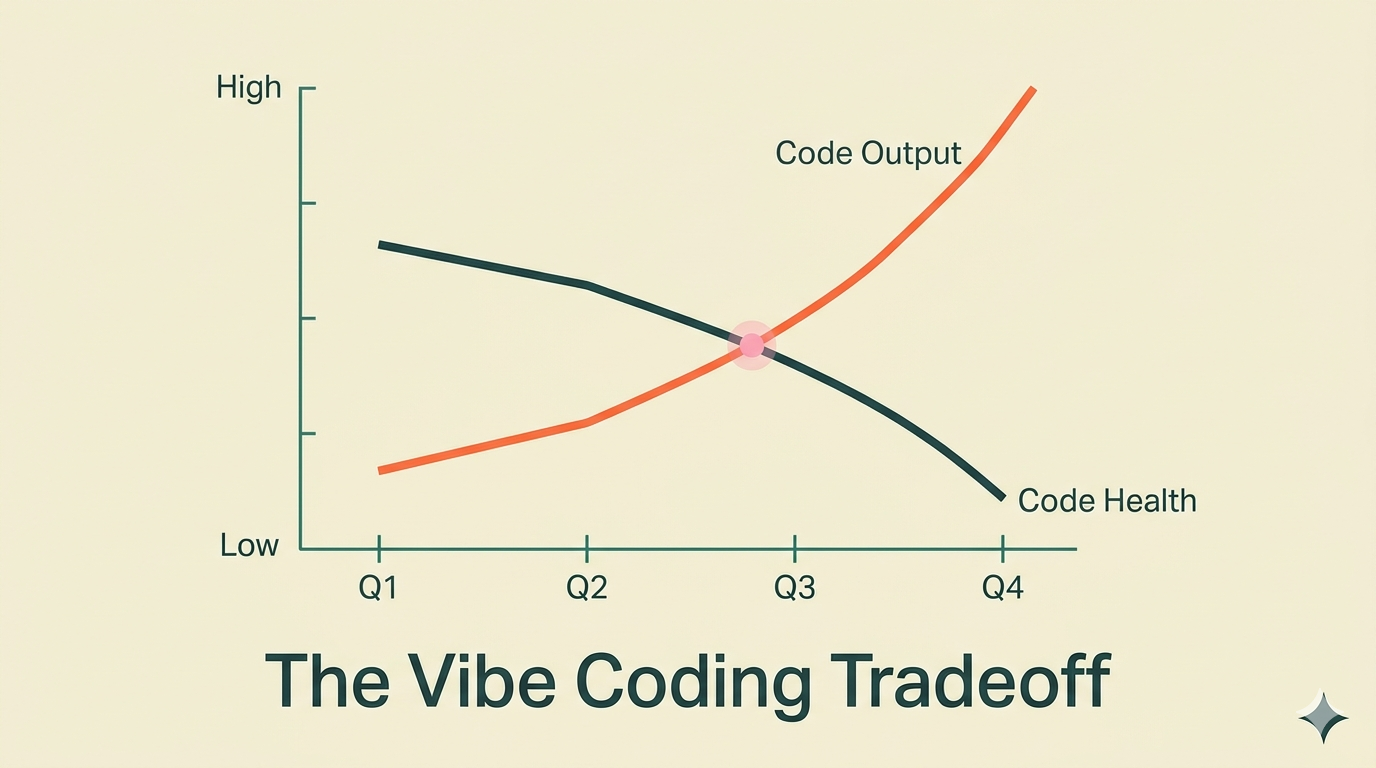
Vibe coding — using AI tools to generate code at high speed — is productive and inevitable. But without guardrails, it creates technical debt at unprecedented speed. The primary risks include architecture erosion, decorative tests with mutation scores as low as 8-15%, ownership voids, and compounding debt. The solution is not to stop vibe coding. It is to pair it with prevention, detection, and correction measures that make it viable for production-grade systems.
Andrej Karpathy coined the term: "fully giving in to the vibes, embrace exponentials, and forget that the code even exists."
He was talking about throwaway prototypes. Weekend projects. Code you'd delete on Monday.
But here's the thing: teams are using it on production codebases. And honestly? The productivity is real. Vibe coding is not a fad. It is not going away. Resisting it is futile — and wrong.
The question is not whether your team will vibe code. The question is whether they'll do it with guardrails or without them.
The Productivity Is Real
Let's be honest about what vibe coding gets right.
A developer opens Cursor or Copilot, describes what they want in natural language, iterates on suggestions, and ships a working feature in 45 minutes. The PR is 400 lines. The feature works. Velocity charts climb.
This is not an illusion. AI-assisted development genuinely compresses the time between intent and working code. The developers who refuse to use these tools will fall behind. That's the reality.
But there's a difference between vibe coding with discipline and vibe coding without it. And that difference is the difference between sustainable speed and a codebase that collapses under its own weight.
What Happens Without Guardrails
When vibe coding operates without structural constraints, specific and predictable risks emerge. These are not hypothetical. They are happening in codebases right now.
Architecture erosion. AI doesn't know your module boundaries. It doesn't know that authentication logic stays out of the API layer. It copies whatever pattern it finds, wherever it finds it. Three months of undisciplined vibe coding and your carefully designed service boundaries are meaningless — there are dependency violations everywhere, and every change has a blast radius that touches half the system.
Decorative tests. AI is excellent at generating tests that pass. It's terrible at generating tests that matter. Run mutation testing on AI-generated test suites and you'll routinely see mutation scores of 8-15% — meaning the tests would still pass even if you deleted 85-92% of the production logic they claim to verify. We covered why this is dangerous in our piece on mutation testing. These aren't tests. They're theater.
The ownership void. When a developer vibe-codes a feature without guardrails, nobody truly understands the implementation. Not the author — they accepted suggestions. Not the reviewer — the PR was 400 lines of AI-generated code. Not the next developer — there's no design intent to trace. When it breaks at 2 AM, the oncall engineer is reading code that no human designed.
Non-deterministic debt. Ask AI to solve the same problem five times and you'll get five different approaches. Undisciplined vibe coding across a team means the codebase accumulates multiple conflicting patterns for the same concern. Five different error handling strategies. Three different ways to validate input. Two different patterns for database access. The codebase stops being a coherent system and becomes a collection of AI experiments.
The Answer Is Not to Stop Vibe Coding
Here's where most commentary on vibe coding gets it wrong. The hot take is "vibe coding is reckless, stop doing it." That's like telling teams to stop using electricity because wiring without circuit breakers is dangerous.
The answer is circuit breakers.
The answer is a closed-loop system of guardrails — Prevention, Detection, and Correction — that lets teams capture the speed of vibe coding without accumulating the debt.
Prevention stops bad code from entering the codebase. TDD enforcement means AI generates implementations against human-defined tests, not the other way around. Architecture boundary checks reject commits that violate module boundaries. Quality gates on every commit enforce complexity thresholds, dependency rules, and coverage standards. These aren't guidelines. They're automated gates that run on every push.
Detection finds the problems that slip through. Code health scoring gives teams a continuous, objective measure of codebase quality — not vibes about vibes. Mutation testing reveals whether AI-generated tests actually catch bugs or just pass for show. Pattern analysis identifies conflicting approaches and architectural drift before they compound.
Correction closes the loop. When detection surfaces an issue, safe remediation — targeted, tested, bounded — brings the code back into line. Not a massive rewrite. Not a freeze on AI usage. Surgical fixes that address specific violations, backed by the same test discipline that should have been there from the start.
Gene Kim and Steve Yegge recently made this case in their book on vibe coding for production-grade systems — you can vibe code for production, but you need prevention, detection, and correction measures in place. We'll explore what that looks like in practice in an upcoming piece.
The Bottom Line
Vibe coding is not the problem. Undisciplined vibe coding is.
The teams that win will not be the ones who refuse AI tools. They will not be the ones who generate code the fastest with no constraints. They will be the ones who vibe code with guardrails — shipping fast AND shipping safely.
The vibes are powerful. Pair them with prevention, detection, and correction, and they become sustainable.
That's the future of software engineering. Not slower. Not reckless. Disciplined speed.


