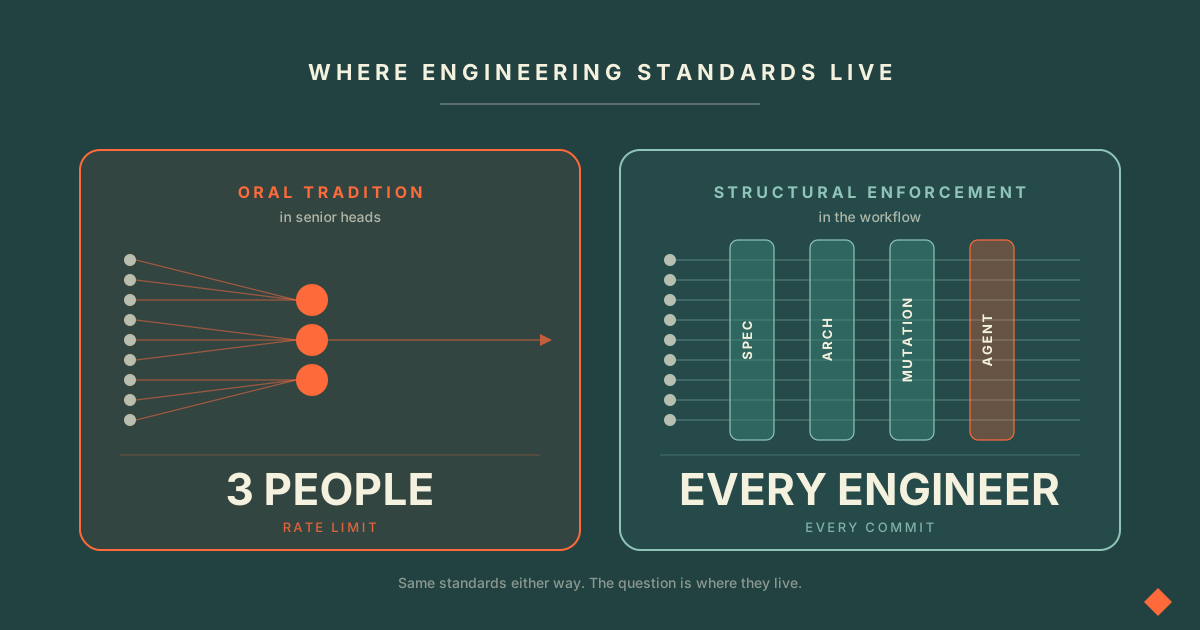
Senior engineers become the bottleneck when engineering standards live in their heads instead of in the workflow. Every architecture decision, every risky PR, and every onboarding conversation routes through three or four people — and senior availability becomes the rate limit on everything the team ships. Democratising engineering excellence means moving that judgment out of oral tradition and into structural gates — executable specs, architecture fitness checks, mutation testing, AI agents with encoded discipline — so the same standards apply on every commit, regardless of who writes it.
Look at where senior engineers' time actually goes.
In most teams it is not designing new systems. It is approving PRs. Answering "is this the right pattern here?" on Slack. Sitting in onboarding sessions. Re-explaining the same architectural decision to the third engineer this quarter. Cleaning up after a junior who shipped something the senior would never have shipped — and that nobody else on the team had the standing to block.
This is the seniority bottleneck. It does not look like a bottleneck because nobody is sitting idle. The seniors are exhausted. The juniors are productive. The PRs are flowing. But the team's effective throughput is capped at whatever the three or four most experienced engineers can personally review and intervene on each week.
You can hire more juniors. You can buy more AI tooling. You can run more retrospectives. None of it raises the ceiling. The ceiling is senior calendar.
The fix is not more seniors. It is moving senior judgment out of their heads and into the workflow.
Where Senior Time Actually Goes
Pick any growing engineering team and instrument where the seniors spend their week. The pattern is consistent across the companies we work with:
- Code review queue. A handful of engineers carry the review load for half the codebase. Median time-to-first-review for those modules sits around 22 hours — not because reviewers are slow, but because the queue keeps refilling faster than they can drain it (the 22-hour code review problem).
- Design Slack threads. "Is this the right place for this method?" "Should this be a new service?" "Does our cache pattern fit here?" Each one is a five-minute answer that adds up to hours per day per senior.
- Onboarding repetition. Every new engineer needs the same architectural tour, the same testing-philosophy conversation, the same "here is why we do it this way" explanation. The transmission medium is a senior's mouth.
- Salvage operations. Something shipped broken. Something broke production. Something needs to be refactored before the next feature can land on top of it. The seniors handle it because they know the codebase well enough to fix it without making it worse.
The juniors and mid-levels in the same team are not under-skilled. They are under-leveraged. They cannot operate at senior quality without the senior in the loop — because the standards that define senior quality are not written down anywhere they can act on them.
That is the actual constraint. Not "we need more senior engineers." It is "our engineering standards are stored in three people's heads."
Why Seniors Became the Enforcement Layer
This did not happen by design. It happened because of how most engineering teams handle quality.
The default model assumes engineering excellence transmits through three mechanisms — and all three rely on a senior being present in the loop.
Code review as enforcement. Standards get applied at PR time, by a senior who reads the diff, recognises a deviation from the pattern, and comments. The standard exists in the senior's head. The PR is the moment of transmission. Without the senior, the standard is silent.
Mentorship as transmission. Patterns get taught through pairing, ad-hoc explanation, and "watch how I do it." The senior is the medium. The new engineer absorbs by proximity. The pattern stays in human memory — and gets re-transmitted, with drift, to the next person.
Heroics as recovery. When something breaks, a senior fixes it. The fix often reveals the gap that caused the break — a missing test, a blurred boundary, a wrong abstraction. That knowledge stays with whoever did the fix. The next person hits the same gap.
Three mechanisms. All routed through humans. All limited by attention, calendar, and turnover. This is oral tradition — the same way pre-literate societies preserved knowledge. It works at small scale. It does not scale past the seniors' bandwidth.
The 3-engineer IIoT team we wrote about previously (200K lines, elite DORA, no seniors) is the proof case in the other direction: when the same standards live in gates instead of heads, junior engineers ship at senior quality. The variable is not talent. It is whether the workflow encodes the discipline.
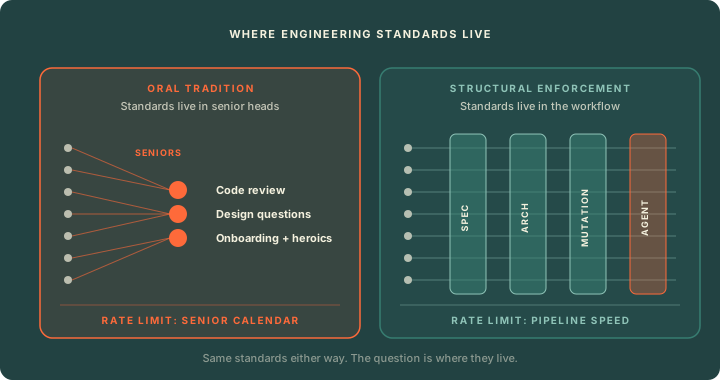
Figure 1: Oral tradition routes every standard through a senior. Structural enforcement encodes the same standards once and applies them on every commit.
What "Democratise" Actually Looks Like
Democratising engineering excellence is not "give everyone the senior title." It is moving the standards out of senior heads and into places every engineer — and every AI agent — can act on them.
Concretely, four moves:
1. Replace "the senior reviews the intent" with executable specifications.
The most expensive senior review is the one that catches "you built the wrong thing." It happens late, after implementation, when the cost of rework is maximum. The fix is to define done before development starts, in a form that does not require senior interpretation.
Example Mapping plus Gherkin acceptance tests turn ambiguous tickets into executable specifications a PM, a junior, and an AI agent can all read. The acceptance test is the contract. The senior's job stops being "translate the spec on every PR" and becomes "approve the spec once, then trust the gate."
2. Replace "the senior reviews the design" with architecture fitness checks.
Most architectural review comments are pattern recognition: "this dependency points the wrong way," "this method is doing two things," "this concern belongs in the application layer." These are codifiable. Architecture fitness functions, complexity thresholds, dependency rules, and clean-architecture boundary checks can run on every commit. The senior's design judgment becomes a build that fails or passes — not a comment thread.
3. Replace "the senior verifies the tests are real" with mutation testing.
The most common quality gap in junior code is decorative tests — tests that execute but do not assert. The senior usually catches this by reading the assertions. Mutation testing catches it structurally: introduce faults into the code, see if the suite detects them. Score below 80%, the build fails. The senior does not have to read the test. The mutation score reads it for them.
4. Replace "the senior cleans up after the AI" with AI agents that operate inside the gates.
AI coding agents amplify whatever your codebase already produces (the pattern amplifier problem). Drop an agent into a team with oral-tradition standards and the agent will produce more code that the senior has to clean up. Drop the same agent into a workflow where standards are gates the agent must pass through — Red-Green-Refactor, architecture rules, mutation score, contract tests — and the agent ships within the same envelope as a senior engineer. The senior reviews the genuinely novel work, not the boilerplate.
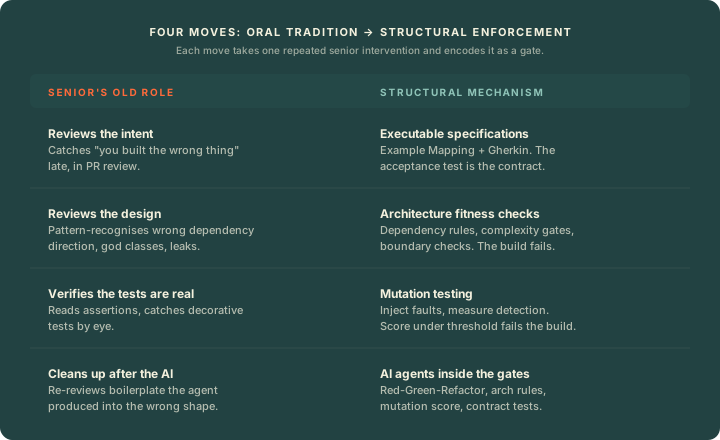
Figure 2: The four moves that shift senior judgment from oral tradition into structural enforcement.
What Changes for Your Senior Engineers
Two predictable concerns come up every time we walk a CTO through this.
"Will my senior engineers feel deprecated?" No, if you frame it correctly. Their leverage changes, not their value. Instead of being the rate limit on every PR, they become the people who design the gates. Defining the Example Mapping practice, encoding the architecture rules, choosing the mutation operators, training the AI agent prompts — these are senior-level activities, and they scale to every commit instead of one PR at a time. The seniors we have worked with through this transition uniformly describe the change as "I finally get to do the work I was hired for."
"Won't this just slow things down with more gates?" Only if the gates are bolted on after development. When the gates are part of the workflow from the first line of code, they replace the late-stage senior review cycle — which is where the actual slowdown lives. The 22 hours of wait time on a senior PR review compresses to a build that runs in minutes. The senior is no longer on the critical path for typical changes; they are on the critical path only for the changes that genuinely need their judgment.
The structural enforcement does not eliminate senior judgment. It eliminates the bottleneck of senior judgment having to happen one PR at a time.
What to Do This Quarter
You do not need to overhaul the team. Four moves, sequenced over a quarter:
-
Audit where senior time goes. Pick two senior engineers. For two weeks, have them log every interruption longer than 15 minutes — what was it, what category did it fall into, did it need their specific judgment or could it have been a rule. The data is usually obvious within five working days.
-
Pick one repeated pattern and encode it. The most common one we see is "the senior keeps catching the same architectural mistake on PRs." Write the rule as an architecture fitness check in CI. The next time the mistake happens, the build fails instead of the senior commenting. That is one decision moved from oral tradition to the workflow.
-
Run mutation testing on one critical module. Pick the module that breaks most often. Run mutation testing. Show the gap between coverage percentage and mutation score to the team. This is the most efficient way to expose the "decorative tests" problem without singling anyone out — and it is the single highest-leverage gate to add first.
-
Designate a senior as the workflow owner, not the review owner. Their job for the next quarter is encoding the standards, not approving the PRs. Measure them on how many of the recurring senior interventions they convert into structural gates. Watch the review queue shrink as a side effect.
The goal is not to remove senior engineers from the loop. It is to remove them from the loops where they are not adding leverage — and free their judgment for the work that only they can do.
The Bottom Line
If three engineers in your team are on the path of every important decision, you do not have a strong engineering culture. You have a single point of failure dressed up as expertise. Senior engineers are not supposed to be a quality control layer applied one PR at a time — they are supposed to be the people who design the system that makes quality structural. Democratising engineering excellence is the move from oral tradition to encoded discipline: standards in pipelines, intent in executable specs, design in fitness checks, tests verified by mutation, AI agents operating inside the same gates. The senior's expertise stops being the rate limit and starts being the multiplier.


