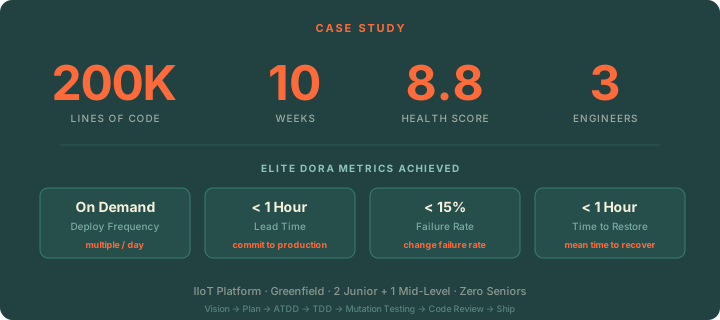
Three engineers — two junior, one mid-level — shipped 200,000 lines of production-grade code for an Industrial IoT platform in ten weeks, achieving elite DORA metrics and an 8.8/10 code health score from the first commit. The difference was not talent or experience. It was structural enforcement: a workflow that made engineering discipline the default, not the aspiration.
Here's a question that shouldn't be controversial but is: Can junior engineers build production-grade systems?
The industry's answer is usually no — not without senior oversight, not without years of experience, not without someone who's "been through it." The assumption is that engineering quality comes from seniority. Seniors know the patterns. Seniors catch the mistakes. Seniors enforce the standards.
But what if the standards enforced themselves?
The Project
An equipment manufacturer needed an Industrial IoT platform — real-time monitoring, predictive maintenance, intelligent alerting across manufacturing facilities. Edge-based data processing with sub-second latency. Multi-protocol support for Modbus and OPC-UA. Multi-tenant architecture supporting both OEMs and their customers. Compliance with IEC 62443 industrial cybersecurity standards.
This wasn't a CRUD app. It was a distributed system with real-time requirements, protocol translation at the edge, and data flowing from thousands of sensors through gateways to a backend API — all needing to work reliably in environments where unplanned downtime costs manufacturers millions.
The team assigned to build it: two junior engineers and one mid-level engineer. Zero seniors.
The Workflow: Prevention from Day One
Instead of hiring senior engineers to enforce quality through code reviews and mentorship, we embedded enforcement into the development process itself. Every feature followed the same structural workflow — no exceptions, no shortcuts.
Vision → Plan → ATDD → TDD → Mutation Testing → Code Review → Ship
Each phase has a gate. Each gate must pass before the next phase begins. Gates cannot be skipped.
Gate 0: Vision. The product vision was defined in problem-domain language — who the users are, what pain they have, what success looks like. Not technical architecture. Not implementation details. Business outcomes.
Gate 1: Plan. Every feature was decomposed through Example Mapping — identifying business rules, capturing acceptance criteria in user-facing language, and breaking work into TDD tasks. A feature couldn't enter development until the plan was approved.
Gate 2: Acceptance Tests (ATDD). Before writing a single line of production code, the team wrote acceptance tests in Gherkin — plain language scenarios that define what "done" looks like. These tests used a four-layer architecture: Gherkin scenarios at the top, a domain-specific language layer in the middle, driver interfaces below that, and protocol-specific implementations at the bottom.
The DSL layer contained zero implementation details. A product manager could read it and understand what the system does. This wasn't documentation — it was executable specification.
Gate 3: TDD. With acceptance tests defining the target, the team implemented features through strict Red-Green-Refactor cycles. One failing test. Minimal code to make it pass. Refactor. Repeat. The test pyramid was enforced at every level — unit tests, component tests, narrow integration tests, and contract tests via Pact.
Gate 4: Mutation Testing. Code coverage is a vanity metric. A codebase can have 90% coverage and a 20% mutation score — meaning the tests execute the code but don't actually verify its behavior. After TDD, the team ran mutation testing to verify test effectiveness. If a mutant survived — meaning an introduced bug went undetected — the test suite had a gap that needed closing.
Gate 5: Code Review. An automated code review validated architecture compliance, complexity thresholds, maintainability standards, and test effectiveness. Clean Architecture boundaries were checked: no framework dependencies in the domain layer, dependency direction flowing inward only, no circular dependencies. Cyclomatic complexity under 10. Meaningful naming. SOLID principles.
Gate 6: Ship. Commit stage pipeline under 10 minutes. All test layers executing in parallel. Immutable Docker images tagged with commit SHA. Contract tests verifying frontend-backend integration. Deploy on green.
What the Team Actually Experienced
Week one looked slow. The juniors had never written Gherkin scenarios. They'd never done strict Red-Green-Refactor. They'd never seen mutation testing.
But they weren't learning from documentation or wikis that drift out of date. They were learning by doing — with guardrails that caught mistakes before they compounded. The workflow was the teacher.
By week two, the patterns were internalized. The team was writing acceptance tests fluently, TDD cycles were tight, and mutation testing was catching test gaps they wouldn't have noticed for months.
By week four, they were shipping features at a pace that would have been aggressive for a senior team. Not because they were working faster — because the workflow eliminated the rework, the debugging, the "why is this broken in production" cycles that consume most development time.
The Numbers
DORA Metrics: Elite Band from Week One
| Metric | Achieved | Elite Threshold |
|---|---|---|
| Deployment Frequency | On demand (multiple/day) | On demand |
| Lead Time for Changes | < 1 hour | < 1 hour |
| Change Failure Rate | < 15% | 0–15% |
| Mean Time to Restore | < 1 hour | < 1 hour |
These aren't numbers achieved after months of optimization. The team hit elite DORA metrics within the first weeks — because the workflow structurally produces them.
Small, well-tested changes → fast reviews → frequent deploys → low failure rate → fast recovery. Each DORA metric is an outcome of the engineering practices enforced by Prevention, not a target the team was optimizing for.
Code Health: 8.8 / 10
| Dimension | What It Measures |
|---|---|
| Architecture | Clean boundaries, dependency direction, no circular dependencies |
| Complexity | Cyclomatic complexity, nesting depth, method size |
| Maintainability | Naming, readability, duplication, error handling |
| Test Effectiveness | Mutation score, test pyramid coverage, assertion quality |
An 8.8 code health score on a 200K-line codebase means the system is structurally healthy — easy to change, safe to deploy, ready for AI-assisted development. For context, established codebases in the industry typically score between 3.0 and 5.0.
Why This Matters Beyond the Numbers
The Seniority Myth
The industry assumes quality requires seniority. It doesn't. Quality requires discipline — and discipline can be structural.
A senior engineer's value isn't in writing better code. It's in knowing the patterns: write tests first, keep boundaries clean, make changes small, verify behavior not just execution. These patterns are codifiable. They can be encoded into gates that execute on every commit.
This doesn't make senior engineers unnecessary. It means their expertise scales beyond their personal capacity. Instead of one senior reviewing every PR, the senior's judgment is embedded in the workflow — applied to every change, by every engineer, on every project.
The AI Readiness Dividend
A codebase with an 8.8 health score is ready for AI agents from day one. When AI coding tools operate on a healthy codebase — clean architecture, effective tests, clear boundaries — they amplify quality. They follow the patterns because the patterns are structurally present.
When AI tools operate on an unhealthy codebase, they amplify chaos. They generate code faster into broken architecture, ship bugs faster through decorative tests, create larger blast radius changes faster through tangled dependencies.
The IIoT platform was AI-ready from the first commit — not because the team planned for AI adoption, but because the same engineering discipline that produces elite DORA metrics also produces AI-ready code. They're the same thing.
The Greenfield Advantage — and Why Most Teams Miss It
Every greenfield project starts with elite DORA metrics. On day one, deployment is trivial. Lead time is minutes. Change failure rate is zero.
Most teams lose these metrics within weeks. They skip tests under deadline pressure. They let architecture boundaries blur "just this once." They accumulate 50 lines of tech debt, then 500, then 5,000 — and suddenly lead time is 14 days and every deploy is a risk.
The IIoT team didn't lose their elite metrics because the workflow made losing them structurally difficult. You can't skip tests when the gate won't let you proceed without them. You can't blur architecture boundaries when dependency rules are checked on every commit. You can't accumulate tech debt when mutation testing exposes every gap in test effectiveness.
The Platform: Real-Time IIoT at Scale
The system the team built isn't a toy. It's a production Industrial IoT platform with:
- Edge-first architecture — data processed at the gateway with sub-second latency, not round-tripped to the cloud
- Multi-protocol support — Modbus and OPC-UA integration through a clean adapter pattern, extensible to future protocols without core changes
- Multi-tenant architecture — OEMs and their customers collaborate on equipment health management with role-based access control
- Real-time alerting — anomaly detection to operator notification in under 5 minutes
- Industrial compliance — IEC 62443 cybersecurity standards, with data sovereignty and privacy controls for EU customers
The Clean Architecture enforced by Prevention made this complexity manageable. Protocol adapters plug in without touching the domain layer. New tenancy models don't require database schema changes. Real-time and batch processing share the same domain logic through different driver implementations.
This is the architecture a senior engineer would design. It was built by juniors — because the workflow encoded the design principles that a senior would have enforced manually.
What You Can Take From This
You don't need to use Prevention to apply these principles. The practices are well-established:
-
Define done before you start. Write acceptance tests in plain language before writing production code. If you can't describe what "done" looks like, you're not ready to build.
-
Enforce, don't suggest. Guidelines in a wiki are suggestions. Gates in your pipeline are enforcement. The gap between them is the gap between aspiration and achievement.
-
Measure test effectiveness, not coverage. Run mutation testing on your critical paths. The gap between your coverage percentage and your mutation score is the gap between your confidence and your reality.
-
Make discipline structural. If a practice depends on someone remembering to do it, it will be forgotten under pressure. If it depends on a gate that blocks progress, it will be done.
-
Protect your greenfield. Every new project starts healthy. The question is whether your workflow preserves that health as the codebase grows — or whether you're accumulating the debt you'll spend years paying down.
The Bottom Line
Three engineers. Two junior, one mid-level. Zero seniors. 200,000 lines of production code. Eight weeks. Elite DORA metrics. 8.8 code health score.
The variable that made this possible wasn't talent, experience, or heroics. It was a workflow that made engineering discipline the structural default — not a guideline to follow, not a standard to aspire to, but a gate that every commit must pass through.
The question isn't whether your team is senior enough to achieve elite engineering. The question is whether your workflow enforces the discipline that elite engineering requires.


