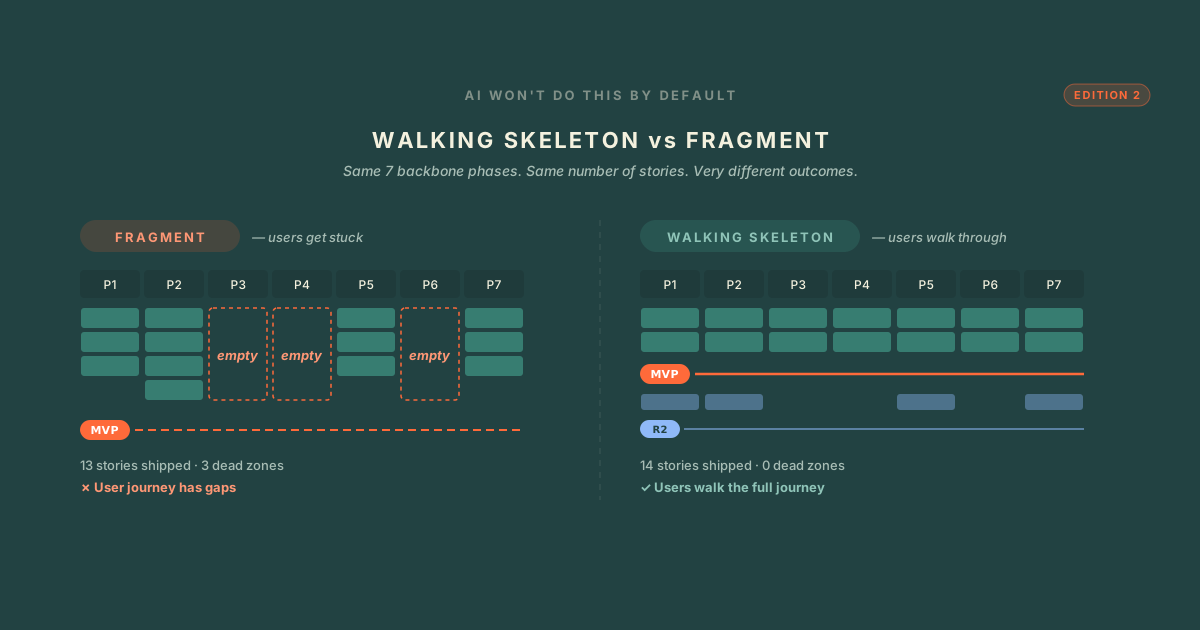
User story mapping is the practice — created by Jeff Patton — of visualizing a product as the user's end-to-end journey instead of a flat backlog. With AI coding agents, it becomes the difference between shipping a coherent product and shipping a fast-moving pile of features. Agents build any ticket brilliantly. They can't see whether the ticket is part of a walking skeleton or a fragment. The map is what tells them — and the team — which one you're building.
This is the second post in "AI Won't Do This by Default — Until You Do." Last week we started at the leftmost shift: hypothesis. Before shape, before code, before tests — the decision to treat every release as an experiment with a measurable signal.
This week, one step right. You have a validated hypothesis. Now you have to figure out where it lives in the user's journey. That's shape, and the working tool for it is user story mapping.
Shape Is the Hinge
The moment a hypothesis is validated, you cross from the problem space (where last week's post lived) into the solution space. The very first thing you do once you're across is not open an editor. It's not write a ticket. It's not prompt the agent. It's shape the response: who does the solution serve, what journey are they on, which slice walks the full skeleton, what outcome does the first release deliver. Story mapping is that work.
Skip it and the agent will happily ship features into a journey nobody has drawn. Hypothesis says why. Shape says how it fits. Then — and only then — does the agent get a story.
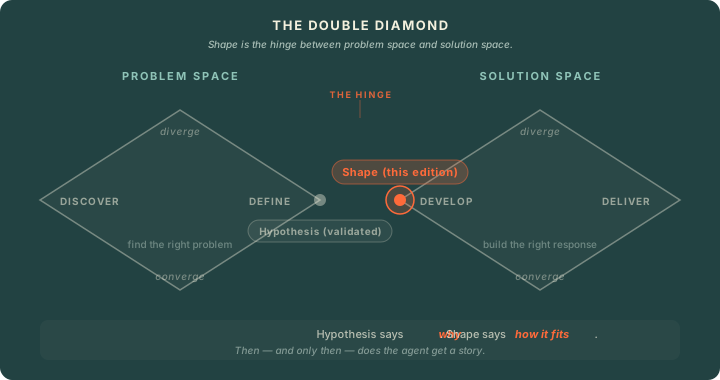
Figure 1: The Double Diamond — shape is the hinge between problem space and solution space.
What the Tool Does — And It's Incredible
Hand Claude Code a story — "Add promo code validation to checkout" — and forty seconds later you have a working implementation, a passing test, and a clean PR. Hand Cursor a ticket and it scaffolds the endpoint, the validation logic, and the error responses. Codex turns a one-line spec into a feature you'd be proud to ship.
This is real. AI agents are extraordinary at turning a story into code. The unit of work — one ticket, one feature — is exactly what they're optimised for. You should absolutely be using them. They are the most powerful execution tool engineering has ever had.
But the unit of work is the trap.
What It Doesn't Do — By Default
Your AI agent won't, by default:
- Ask "where does this story sit in the user's journey?"
- Notice that the journey has a dead zone three phases to the left
- Tell you that this ticket is the eighth story in phase two while phase four still has zero
- Distinguish between a story that's part of a walking skeleton and a story that's part of a fragment
- Detect that product, engineering, and the founder all have a different mental picture of what MVP means
This isn't a flaw — it's the design surface. Agents are story-execution engines. They build what's in front of them. The question of which stories form a coherent journey is yours. And the teams that answer it well before tickets reach the agent? They're the ones whose customers can actually use the product end-to-end at week eight, instead of just admiring how many features got shipped.
The Practice
User story mapping comes from Jeff Patton's book of the same name (O'Reilly, 2014). Three moves.
1. The journey backbone. Across the top of the wall, left to right in time order, you write the sequence of things the user does to get value from your product. Not features. Not screens. The narrative — what happens from the moment they first encounter the product until they're getting ongoing value. Each backbone phase has a goal ("why are they here") and an activity ("what are they doing").
2. Stories stacked by priority. Under each backbone phase, you stack stories vertically — most important at the top, less important below. This is where features live. But unlike a backlog, every story is now anchored to a specific moment in the journey. The agent — and the team — can see which phase this story belongs to, which persona it serves, what comes before and after.
3. Releases sliced by outcome. Horizontal lines cut across the map into releases — MVP, R2, R3 — named by the outcome they deliver, not the features they contain. "Teams self-serve adoption" is a valid R2 name. "Dashboards and email alerts" is not.
The rule underneath all three is the walking skeleton: an MVP is not the smallest feature set, it's the thinnest end-to-end slice where every backbone phase has at least one story. If any phase is empty in MVP, you don't have an MVP — you have a fragment that looks like one. Fragments are easy to build. Walking skeletons are hard. That difference is what story mapping makes visible.
Two MVPs of the Same Product
Make it concrete. You're building a cohort-based learning platform. The user's journey has six backbone phases: Discover a course, Enrol, Learn the content, Practice through assignments, get Feedback from a coach, Complete with a certificate. Two teams agree on the journey. They disagree on what MVP means.
Team A ships a Fragment. Twelve features, all in two phases. Discover gets search, filters, recommendations, ratings, preview clips, instructor profiles. Learn gets a video player, auto-transcripts, notes, bookmarks, speed control, dark mode. The release looks impressive — feature parity with established platforms in two areas. But Enrol, Practice, Feedback, and Complete are empty. There is no payment. No assignment submission. No coach loop. No certificate. The customer demo gets through slide three, hits a dead zone, and stops. The team has shipped a content site, not a learning platform — and worse, has zero data on whether learners actually finish, because no one can finish.
Team B ships a Walking Skeleton. Six features, one per phase. A single landing page. A Stripe payment link. A Loom video embed. A Google Form for assignments. An email reply from the coach. A PDF certificate sent by email. On paper it looks underwhelming. In practice the learner walks the entire journey end-to-end — and the team gets the only signal that matters: completion rate, drop-off phase, where feedback breaks. Sprint two goes deep on whichever phase generated the worst friction. Real evidence, not opinion.
Same product. Same six weeks. Same agents. The Fragment optimised for what was easy to build. The Skeleton optimised for what was useful to learn.
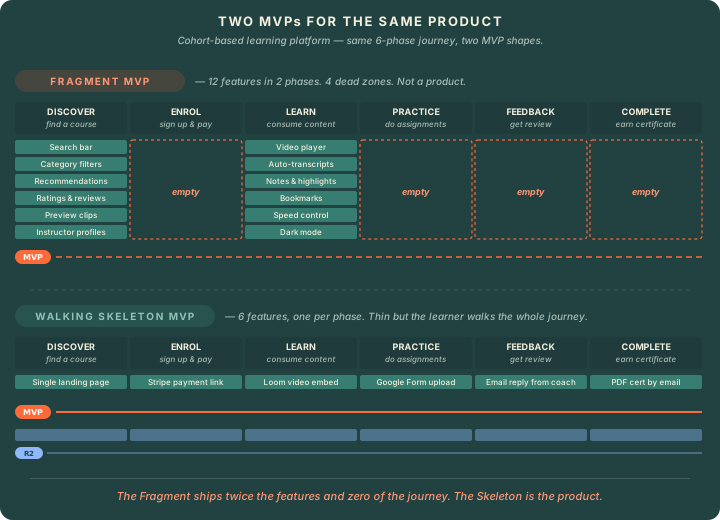
Figure 2: Two MVPs of the same product — the Fragment ships twice the features and zero of the journey.
Why This Practice Is Non-Negotiable Now
Pre-AI, fragments hurt slowly. You'd build in phase two for a couple of sprints, hit the empty phase four trying to demo end-to-end, and course-correct in a sprint or two. The cost of pointing the team in the wrong direction was bounded by how slowly you could point them.
AI agents removed that bound. The same team now ships five to ten features a week instead of one or two — and the blast radius of misdirection scales with velocity. The practice didn't get harder. The cost of skipping it 10×'d. Velocity hides direction. The team ships ten stories a week, ten stories looks like progress, nobody steps back to ask whether those stories form a journey a user can walk. By week six the backlog is thirty features deep, the agent is humming, and two backbone phases still have zero stories. The customer demo lands at one of those dead zones and the deal goes cold.
The reverse case is what you're actually after. A team with a story map and AI agents can fill the walking skeleton — every backbone phase, one thin story — in days instead of weeks. Once the skeleton walks, now you optimise: pick the phase with the worst experience and stack it deeper. The agent ships at machine speed; the map ensures the speed is going somewhere coherent.
AI accelerates execution. Story maps accelerate alignment. Combine them, and you build the right product fast instead of the wrong product faster.
Story mapping has a property nothing else gives you: the conversation is the deliverable. A map produced alone at midnight is a decorated backlog. A map drawn together is the only artefact that surfaces the moment when product says "MVP is the full checkout journey" and engineering says "MVP is core payment processing" — before the agent has shipped six weeks of code resolving that ambiguity in a direction nobody agreed on.
What This Means for Your Team
Next time a story is about to land at your AI agent, ask four questions before anyone opens an editor:
- Where does this story sit in the journey? Which backbone phase?
- Does the MVP skeleton walk? Every phase covered, or are we deepening one while another sits empty?
- Is this story serving the user or the buyer? (For B2B, both need a skeleton.)
- What outcome does this release deliver? If you can't name the outcome, the slice isn't a release — it's a checkpoint.
The first time you do this it feels mechanical — four questions on a sticky next to your monitor. By the tenth cycle it's reflex; you can't look at a ticket without seeing the journey it sits inside. By the thirtieth, the team draws the map together in twenty minutes and the agent ships the entire walking skeleton inside a sprint. That's where the multiplier compounds — not in any one ticket, but in the fact that every ticket the agent ever touches is already in the right place. Teams that reach this point ship outcomes their competitors literally cannot explain — same tools, same headcount, an order of magnitude more coherent product per quarter.
Then hand the story to the agent. It will build it brilliantly. Now it's building it brilliantly in the right place, as part of a journey that walks.
That's the unlock. Not AI alone. Not story mapping alone. The combination.
AI x mastery = results nobody else can explain. AI x no discipline = faster mediocrity.
Your competitors have the same agents you do. The question isn't whether they ship fast. The question is whether what they're shipping is a journey a customer can walk — or a feature pile that looks impressive on a release-notes page.
For the deeper version — evidence-based personas, the B2B two-skeleton rule, and how shape integrates as a feedforward control upstream of the agent harness — see Build the Right Thing, Right: The Shape Discipline.
This is part of the "AI Won't Do This by Default — Until You Do" series. Next up: Event Storming and Bounded Contexts — because once you know the journey, you still have to decide where the seams are.


