AI coding agents are the most powerful tools engineering has ever had. Claude Code, Cursor, Codex — they can implement a feature in hours that used to take a sprint. But the teams getting unreal results aren't just using these tools. They're combining them with hypothesis-driven development — treating every release as an experiment with a testable signal. That combination turns AI from a fast code generator into a learning machine that validates assumptions at a speed that wasn't possible before.
This is the first post in a series called "AI Won't Do This by Default — Until You Do." Each post walks one step along the delivery value stream — from hypothesis to production — and shows what AI tools do brilliantly, what they don't do by default, and what happens when you add the practice that unlocks their real power.
AI x mastery = results nobody else can explain. AI x no discipline = faster mediocrity.
We start at the very beginning. Before shape. Before code. Before tests. The practice that determines whether your AI agent builds an experiment or builds a guess.
What the Tool Does — And It's Incredible
Let's be clear: AI coding agents are a genuine superpower. Give Claude Code a feature description, and it builds it — with tests, with proper architecture, often better than you'd have written by hand. Give Cursor a ticket, and it writes code that works. Give Codex a spec, and it generates an implementation you'd be proud to ship.
These tools have compressed weeks of work into hours. Teams that use them well are shipping at a pace that would have been fantasy two years ago. You should absolutely be using them. Every team should.
But here's what separates the teams getting unreal results from the teams just shipping faster: what they feed the AI before they prompt it.
What It Doesn't Do — By Default
Your AI agent won't, by default:
- Ask "why are we building this?"
- Define a testable hypothesis with a measurable signal
- Set explicit scope boundaries based on what you're trying to learn
- Refuse to proceed without success metrics
- Distinguish between a feature request and a validated need
This isn't a flaw — it's a design reality. AI agents are execution engines. They're built to build. The question of what's worth building is yours. And the teams that answer that question well before prompting? They're the ones getting outcomes that make everyone else wonder what tool they're using. (It's the same tool. The difference is the input.)
The Practice
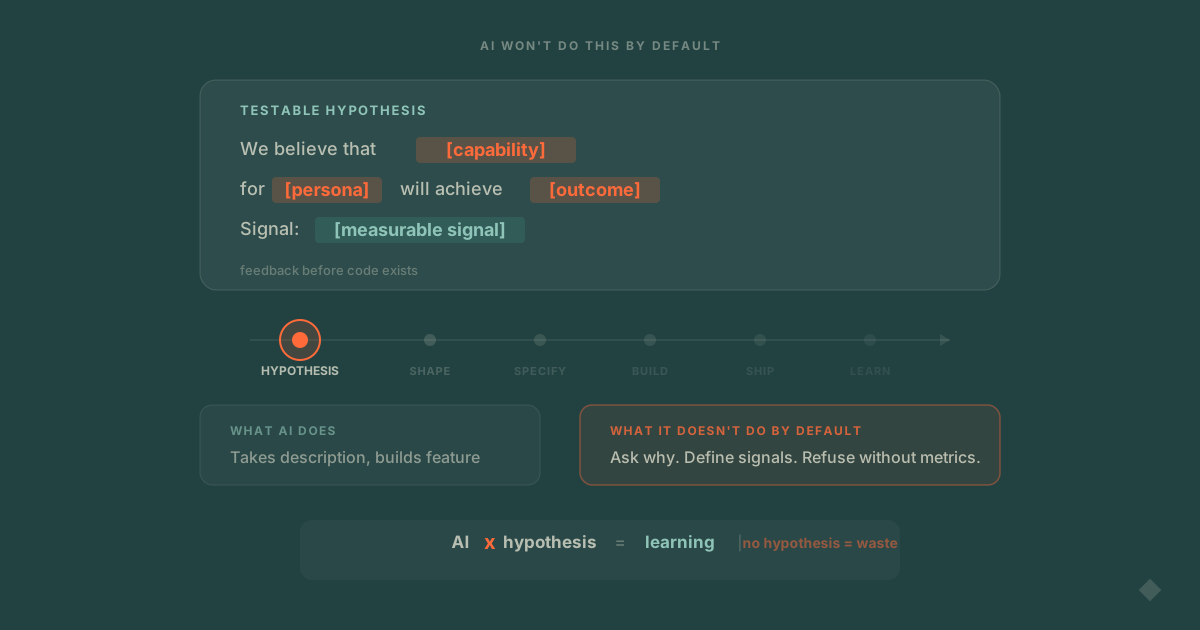
Hypothesis-driven development treats every feature as an experiment. Instead of "build feature X," you start with a statement:
"We believe that [this capability] for [these users] will achieve [this outcome]. We'll know we succeeded when [this measurable signal]."
This isn't ceremony. It's four decisions:
- Who — which persona, with which job-to-be-done?
- What — what's the smallest capability that tests the belief?
- Why — what outcome do we expect, and for whom?
- Signal — what measurable change tells us we were right or wrong?
Each release reduces risk across four dimensions: Value (does it matter?), Usability (can users do it?), Feasibility (can we build it?), Viability (should the business invest?). The hypothesis makes these dimensions explicit. Without it, you're shipping and hoping.
The signal is the most important part. A feature without a signal is an experiment without a measurement — you can't learn from it, you can't know if it worked, and you can't decide whether to persevere or pivot.
Why This Practice Unlocks Everything
Here's why this matters more now than ever — and why it's an opportunity, not a warning.
Before AI tools, testing a hypothesis took a sprint. You'd spend two weeks building the smallest slice, ship it, wait for data. Learning was slow because building was slow.
Now? Claude Code can implement that slice in hours. Cursor can scaffold the experiment in an afternoon. The feedback loop between "hypothesis" and "evidence" has collapsed from weeks to hours.
That means a team with hypothesis discipline and AI agents can run demand tests at a pace that was physically impossible before. Not A/B tests on button colors — that's usability testing, a different practice. Demand testing: does this capability matter? Is there a real need? Will it produce the business outcome we predicted? You build the smallest slice that answers that question, ship it, and check the signal. With AI agents, that cycle takes days instead of months.
AI accelerates execution. Hypotheses accelerate learning. Combine them, and you get learning at machine speed.
The math is simple. A hypothesis conversation costs an hour. With AI, the build takes hours instead of sprints. That means you can go from hypothesis to evidence in a day — something that used to take a month. Teams doing this are operating in a fundamentally different category.
The leftmost shift isn't TDD. It isn't shape. It's the hypothesis — the decision to treat delivery as evidence generation, not output production. And with AI agents, evidence generation happens at a speed that changes what's possible.
What This Means for Your Team
Next time a feature lands in your backlog, ask four questions before anyone opens an editor:
- What's the hypothesis? "We believe that ___ will result in ___."
- What's the signal? "We'll know it worked when ___."
- What's the smallest slice that tests it? Not the full feature — the minimum that generates evidence.
- What would change our mind? If the signal says no, what do we do differently?
Then hand that to your AI agent. Watch what happens. Instead of building a feature, it builds an experiment. Instead of shipping code, you ship a test of your belief — and you get evidence back in hours, not months.
That's the unlock. Not AI alone. Not practices alone. The combination.
AI x mastery = results nobody else can explain. AI x no discipline = faster mediocrity.
Your competitors have the same AI tools you do. The question isn't whether to use them — of course you should. The question is: what are you feeding them?
This is part of the "AI Won't Do This by Default — Until You Do" series. Next up: User Story Mapping and Shape — because even a good hypothesis needs a map before it needs code.


