Clean Architecture's dependency rule — all dependencies point inward, domain knows nothing about infrastructure — has become critical in AI-assisted development. AI coding agents pattern-match from existing code and replicate whatever boundaries (or violations) they find. One architecture violation becomes a template that AI reproduces at scale. Enforcing boundaries structurally, not through code review, is now a prerequisite for safe AI-assisted development.
Your senior architect spent six months designing Clean Architecture boundaries. Domain layer isolated. Dependencies pointing inward. Ports and adapters separating business logic from infrastructure.
Then the team started using an AI coding agent. Three weeks later, there are database imports in the domain layer, HTTP clients in use cases, and framework dependencies scattered everywhere.
Nobody intended it. Nobody approved it. The agent followed the patterns it found — and somewhere in the codebase, it found a shortcut.
Architecture Was Optional. Now It's Mandatory.
Here's the uncomfortable truth about Clean Architecture before AI: most teams didn't enforce it, and most teams survived anyway.
Boundary violations happened. A developer under deadline pressure would import a database client directly in a use case instead of going through the repository port. The senior engineer would catch it in review — sometimes. The violation would sit there, harmless enough, for months.
The cost was manageable because humans produce code slowly. At one or two violations per week, a senior engineer reviewing PRs could contain the damage. Architecture guidelines in a wiki, reinforced by code review, were "good enough."
That calculus changed when AI started writing nearly half the code.
AI coding agents don't read your architecture decision records. They don't check your wiki. They pattern-match from what exists in the codebase. And they do it at a scale and speed that makes code-review-based enforcement impossible.
One boundary violation in a codebase with AI agents is not one violation. It's a template.
What Boundaries Actually Protect
Before we talk about what AI does to architecture, let's be precise about what Clean Architecture boundaries actually are — because most discussions confuse folder structure with architecture.
Clean Architecture has one rule that matters: the Dependency Rule. All source code dependencies point inward. The domain layer knows nothing about the infrastructure that surrounds it. Use cases orchestrate domain logic without knowing whether data comes from PostgreSQL, a REST API, or an in-memory store. The outer layers — controllers, repositories, gateways — depend on the inner layers, never the reverse.
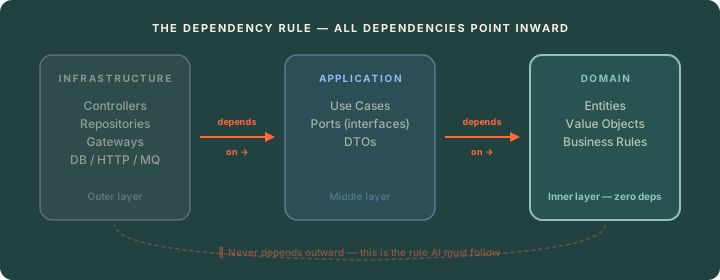
Figure 1: The Dependency Rule — all dependencies point inward. Domain and application layers never reference infrastructure or frameworks.
This rule gives you three things that matter enormously in the age of AI:
Changeability. When the domain doesn't know about PostgreSQL, you can swap PostgreSQL for DynamoDB without touching business logic. This matters when AI agents suggest infrastructure changes — the blast radius is contained to the outer layer.
Testability. When use cases depend on interfaces (ports) rather than implementations, you can test them with in-memory fakes. As we explored in our TDD post, TDD naturally produces these boundaries through design pressure — the test forces you to inject dependencies rather than hardcoding them.
AI-readiness. When boundaries are explicit — each layer has clear imports, each module has a public API — an AI agent has strong signals about where new code belongs. The architecture constrains the solution space to correct answers.
How AI Breaks Boundaries at Scale
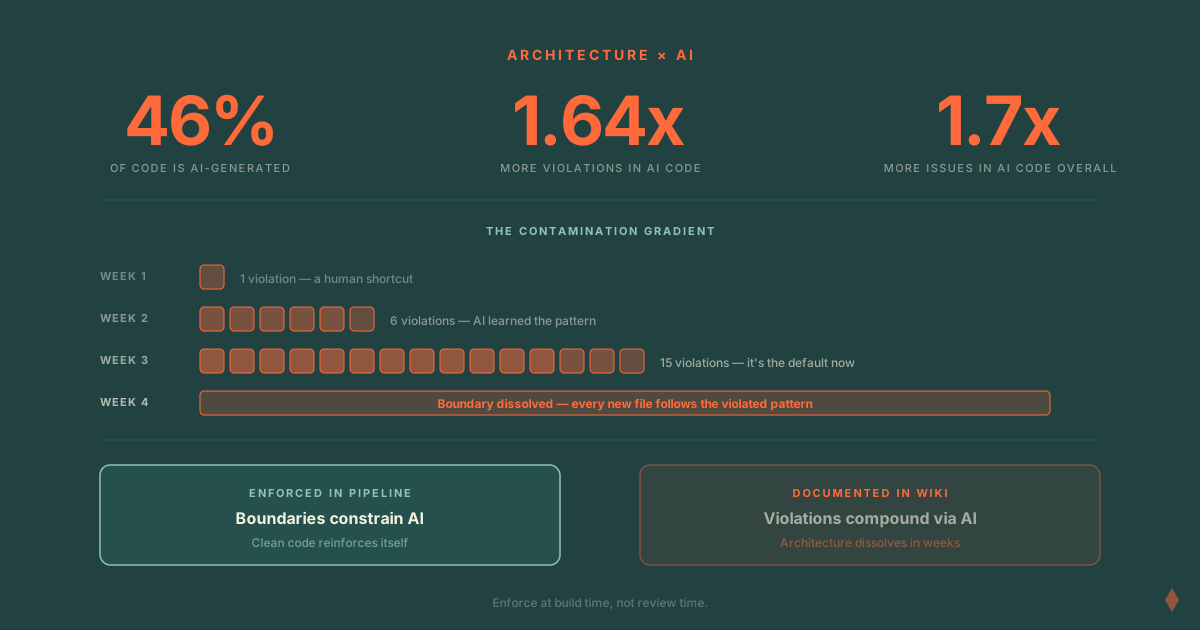
AI agents break architecture through a mechanism we call the contamination gradient. It works like this:
Stage 1: The seed violation. A human developer adds a direct database import in a use case. Maybe under deadline pressure, maybe because the repository interface felt like unnecessary ceremony. A single file, a single import. The tests pass. The PR gets approved.
Stage 2: AI learns the pattern. The AI agent is asked to create a new use case. It scans existing use cases for patterns. It finds that some use the repository port and some import the database directly. Both patterns exist. The agent picks whichever seems more relevant — and for a data-heavy use case, the direct import looks like the better match.
Stage 3: The pattern propagates. The AI generates three more use cases that week. Two of them use direct database imports. The ratio of "clean" to "violated" use cases shifts. By next week, the violated pattern is the majority pattern. The AI now defaults to it.
Stage 4: The boundary dissolves. Within a month, the architecture boundary between the application layer and the infrastructure layer is meaningless. Not because anyone decided to abandon it — because AI generated dozens of files that don't respect it, and each new file reinforced the violation.
This isn't hypothetical. CodeRabbit's 2025 analysis of 470 open-source pull requests found 1.64x more maintainability issues in AI-generated code compared to human-written code. Those maintainability issues include exactly this: misplaced dependencies, layer violations, coupling that shouldn't exist.
The Screaming Architecture Principle
Robert C. Martin introduced the concept of "screaming architecture" — the idea that your codebase's structure should scream its intent. A healthcare system's folder structure should tell you it's a healthcare system, not that it's a Spring Boot application.
This principle matters more than ever because your codebase structure is documentation for AI agents.
When an AI agent generates new code, it uses your file system as a map. File names, folder structure, import paths, module boundaries — these are the signals that tell the agent where things go.
Consider two project structures:
# Structure A: AI has no signals
src/
  services/
    userService.ts
    orderService.ts
    paymentService.ts
  models/
    user.ts
    order.ts
  utils/
    database.ts
    emailClient.ts
    validation.ts
# Structure B: AI knows exactly where things go
src/
  domain/
    entities/
      user.entity.ts
      order.entity.ts
    value-objects/
      email.value-object.ts
  application/
    use-cases/
      register-user.use-case.ts
      place-order.use-case.ts
    ports/
      user.repository.ts
      payment.gateway.ts
  infrastructure/
    persistence/
      postgres-user.repository.ts
    external/
      stripe-payment.gateway.ts
  presentation/
    controllers/
      user.controller.ts
In Structure A, the AI has no signal about boundaries. "Services" can depend on anything. "Utils" is a junk drawer. When asked to "add a payment retry feature," the AI will put database calls, HTTP clients, and business logic wherever seems convenient.
In Structure B, the architecture screams. The AI sees that use cases live in application/use-cases/. It sees that they depend on ports in application/ports/. It sees that implementations live in infrastructure/. When asked to add a payment retry feature, the constraints are visible: create a use case, define a port if needed, implement the port in infrastructure.
The folder structure isn't just organization — it's a constraint mechanism for AI generation.
Enforcement at Build Time, Not Review Time
The critical shift for the age of AI: architecture boundaries must be enforced in the pipeline, not in code review.
Code review was the traditional enforcement mechanism. A senior engineer reads a PR, spots a boundary violation, requests changes. This worked at human speed. It fails at AI speed for three reasons:
-
Volume. AI-generated PRs are larger and more frequent. A senior engineer cannot review 400 lines of AI-generated code with the same rigor as 50 lines of human-written code.
-
Subtlety. Architecture violations in AI-generated code are often structurally correct — they compile, pass tests, and work. The violation is in the dependency direction, which requires understanding the full architecture to spot.
-
Speed. By the time a review catches a violation, the AI has already used that pattern in three other files. You're always behind.
The fix is architecture fitness functions — automated checks that run on every commit and break the build on violation.
Dependency direction checks. No file in domain/ may import from infrastructure/ or presentation/. No file in application/ may import from infrastructure/. These rules are expressible as import restrictions and can be checked in seconds.
Module boundary enforcement. Each module exposes a public API through an index file. Internal files cannot be imported directly from outside the module. This prevents AI agents from reaching into another module's internals.
Circular dependency detection. Circular dependencies confuse both humans and AI agents. They create unpredictable side effects and make it impossible to reason about change impact. Automated detection on every commit prevents them from forming.
Complexity thresholds. When a class or module exceeds a complexity threshold, the build fails. This catches the "god class" pattern that AI agents tend to grow by adding methods to the nearest existing file.
These checks turn architecture from a suggestion into a structural constraint. An AI agent generating code that violates boundaries gets immediate feedback: the build fails. It adjusts. The violation never enters the codebase.
What Changes in Practice
When architecture boundaries are enforced structurally, the relationship between AI agents and your codebase fundamentally changes.
AI becomes constrained, not unbounded. The agent generates code within a defined solution space. A new use case goes in the right folder, depends on the right interfaces, and stays isolated from infrastructure. Not because the agent "understands" architecture — because the boundaries make violations impossible to ship.
Code review shifts from gatekeeping to strategy. Instead of senior engineers spending hours spotting boundary violations, they review the design decisions: is this the right use case? Is this the right abstraction? The mechanical enforcement is handled by the pipeline.
The codebase gets healthier over time, not worse. This is the compound effect. Clean boundaries mean AI generates code that follows clean patterns. Those clean patterns become the majority. The AI's next generation follows them even more consistently. The architecture reinforces itself.
New team members become productive faster. When the architecture screams its intent through folder structure and the pipeline enforces boundaries, a new engineer — or a new AI agent — can contribute correctly on day one. The codebase itself teaches the conventions.
The Bottom Line
Clean Architecture was always a good investment. In the pre-AI era, it reduced coupling, improved testability, and made systems easier to change. But violations were manageable because humans coded slowly and reviews caught most problems.
With AI generating nearly half of all code at 10x speed, architecture boundaries are no longer a quality investment — they're a safety mechanism. The teams that enforce boundaries structurally will get extraordinary value from AI agents. The teams that rely on wiki documentation and code review will watch their architecture dissolve at a pace no amount of reviewing can contain.
Your architecture doesn't need to be perfect. It needs to be enforced. The difference between those two things is the difference between an architecture that survives AI and one that doesn't.


