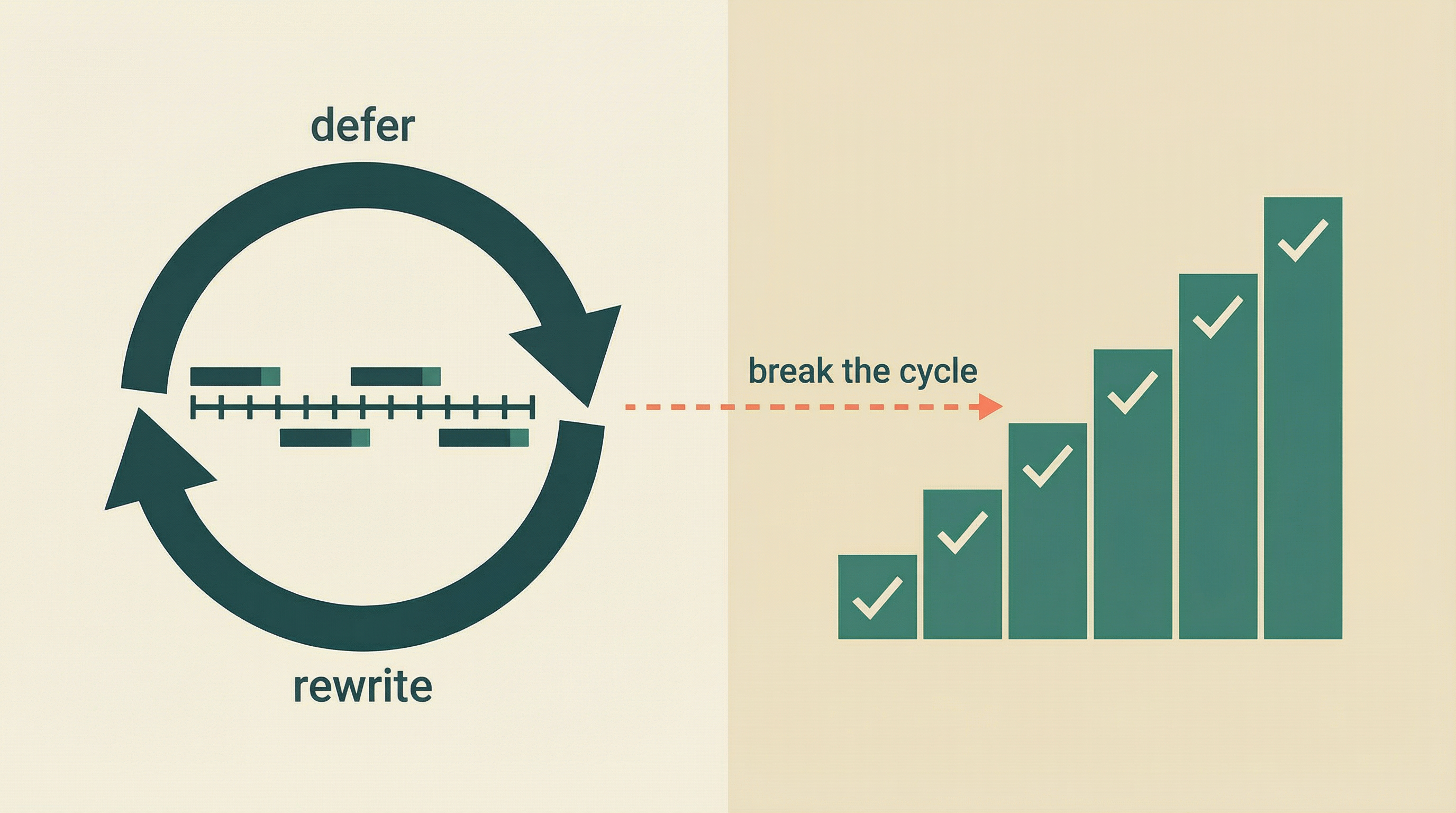
Engineering transformations fail when teams defer improvement to a rewrite that never ships. The rewrite trap compounds tech debt, prevents organizational learning, and delays the very practices it promises to enable. Incremental adoption of continuous delivery on the existing system beats waiting for a future system every time.
Every engineering leader has heard the pitch. "The current system is too far gone. We need a rewrite. Once the new platform is ready, we will adopt CD, write proper tests, enforce architecture boundaries. Give us 12 months."
Twelve months later, the rewrite is 60% complete. The existing system has gotten worse. The team has adopted zero new practices. And someone is asking for six more months.
This is the rewrite trap. It is the most common way engineering transformations die.
The Pattern: Deferring Improvement to a Future That Retreats
The rewrite trap has a few recognizable variants, but the mechanism is always the same. The team identifies a legitimate problem with the existing system and concludes that improvement requires replacing it.
The variants sound like this:
- "We cannot adopt CD until the new platform arrives." The platform is 18 months away. It has been 18 months away for a year.
- "We need full containerization before building the pipeline." Containerization becomes the prerequisite for every improvement.
- "The legacy codebase is untestable. The new system will have tests from day one." The new system is being built by the same team that never wrote tests.
- "Once we migrate to the new CI tool, we will build the pipeline." The tool migration becomes the bottleneck for all process improvement.
The telltale sign is a phrase that has appeared in planning conversations for over a year with a completion date that has moved at least twice: "once we finish the rewrite."
Why the Trap Compounds
The rewrite trap is not a static problem. It accelerates. Four compounding effects make the situation worse with every quarter that passes.
Quality degrades on the existing system
The team has mentally abandoned the current codebase. New features receive minimal engineering care because "it is going away anyway." Tech debt accumulates faster under the assumption the system is temporary. Bugs that automated tests would catch ship to production because nobody invests in testing a system marked for replacement.
The users do not know the system is temporary. They experience the bugs.
Rework multiplies during migration
Edge cases undocumented in the old system must be reverse-engineered during migration. Implicit behavior that nobody remembers building becomes scope creep. Architectural problems that tests would have surfaced years ago are discovered during the rewrite, when fixing them is most expensive.
Teams estimate rewrites based on the system they think they have. They discover the system they actually have six months in.
Delivery timelines become fiction
The team is now delivering against two roadmaps: keeping the existing system running while building the replacement. Both slip. The existing system's delivery remains painful because nobody improved it. The new system's timeline is aspirational because the scope keeps growing.
Leadership sees two underperforming projects instead of one.
The organization never learns
This is the most damaging effect. Teams that never practice continuous delivery on existing systems do not build organizational muscle memory. Deployment automation experience is not transferred. Testing discipline is not learned. It is only deferred.
When the new system finally launches, the team practices CD for the first time at scale, under production pressure, with zero institutional experience. The same patterns that made the old system painful re-emerge within months.
The "We Are Different" Reinforcement Loop
The rewrite trap feeds on a belief that the current situation is uniquely difficult. "Our system is too old." "We are too regulated." "Our domain is too complex." "Our customers will not accept the risk."
Each reason not to start is accepted. Delivery problems persist. The persistence becomes evidence that the system really is too hard. The next reason feels even more credible.
This is a reinforcement loop, not an analysis. Banks practice CD. Healthcare systems practice CD. Defense contractors practice CD. The constraints are real, but they apply to specific practices, not all practices. Using a constraint against one practice to reject all improvement is how the trap self-reinforces.
What Actually Works: Incremental Improvement on the System You Have
The alternative to the rewrite trap is not "do not rewrite." Some systems genuinely need replacement. The alternative is: do not defer improvement to the rewrite.
The strangler fig approach
Pick one CD practice. Apply it only to new code in the existing system. The testable fraction grows over time. The rewrite is not a prerequisite. Team agreement is.
Week 1: Agree that all new code must have automated tests. Not old code. New code only.
Weeks 2-8: Automate deployment of the existing system. This is not wasted work. Deployment automation skills transfer directly to the new system. The team that has automated one deployment pipeline builds the second one in a fraction of the time.
Month 2 onward: Measure what matters. Track release frequency, lead time, change fail rate. These metrics improve incrementally. They do not require the rewrite.
Set explicit completion criteria for the rewrite
If the rewrite is happening, give it a boundary. Define what "done" means before starting. Without explicit criteria, the rewrite becomes a permanent deferral mechanism. The horizon retreats indefinitely.
"The rewrite is done when services X, Y, and Z are migrated and the old system handles zero production traffic" is a completion criterion. "The rewrite is done when the new system is ready" is not.
Stop treating the existing system as disposable
The most damaging decision is not the rewrite itself. It is the implicit permission to stop caring about the current system. Every feature added without tests, every deployment done manually, every architectural shortcut justified by "it is going away" makes both the existing system and the eventual migration harder.
The rewrite does not excuse abandoning engineering discipline on the system your users depend on today.
The AI Multiplier
This pattern has become more urgent in the past year. Teams adopting AI coding tools on codebases without strong foundations see the rewrite trap accelerate. AI agents amplify whatever patterns exist. On a codebase where shortcuts are normal, AI produces shortcuts faster. On a codebase where tests are decorative, AI generates more decorative tests.
The instinct is familiar: "We will adopt AI properly on the new system." The same deferral. The same retreating horizon.
The teams seeing real results from AI are the ones that invested in their existing system first. Strong test suites, enforced architecture boundaries, and automated quality gates make AI tools productive. Without those foundations, AI just makes the rewrite trap spin faster.
The Bottom Line
The rewrite trap is not a technical problem. It is an organizational coping mechanism. Teams defer improvement because starting is harder than planning. But every quarter spent waiting for the rewrite is a quarter where the existing system degrades, the team learns nothing, and the transformation stalls.
Start with what you have. Improve incrementally. Measure the results. The rewrite can still happen. But the practices that make it succeed are the same ones you should be adopting today.


