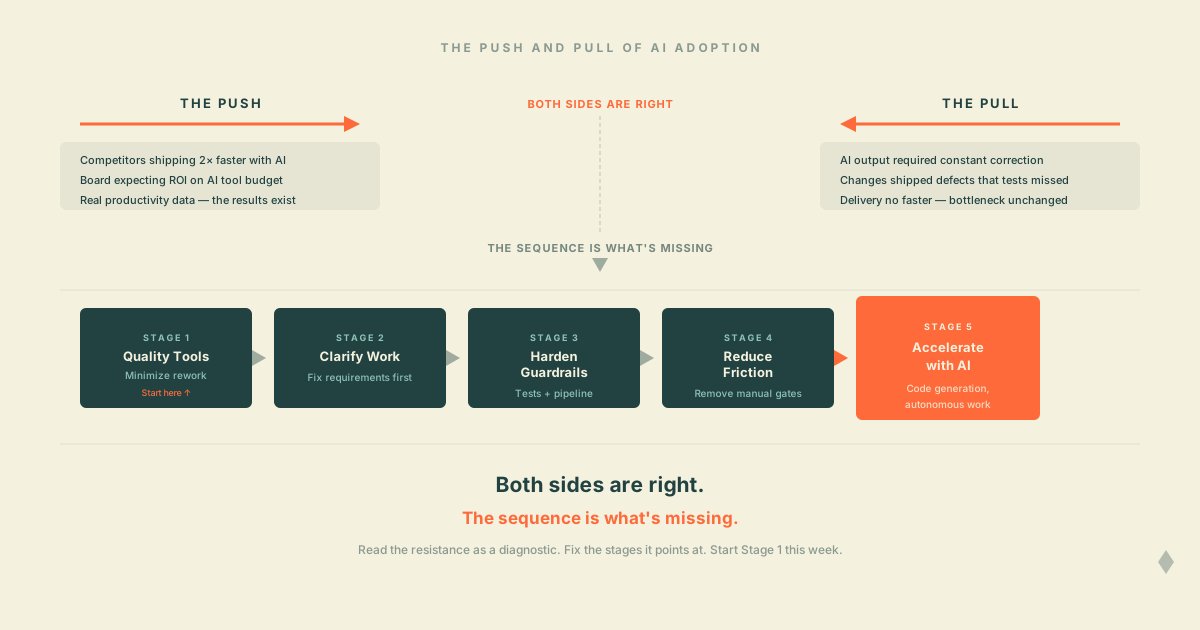
Engineering resistance to AI tools is almost always rational — teams that have tried AI on a process that was not ready for acceleration have experienced what happens when the sequence is skipped. The teams achieving elite AI adoption rates built the foundation first: quality tools, clear requirements, hardened guardrails, reduced delivery friction. Only then does accelerating with AI produce the results the success stories describe. The specific complaints engineers raise about AI tools map directly to the specific stage that is incomplete.
The board meeting goes predictably. A competitor is shipping features twice as fast. The AI tool budget is on the slide. The question: why aren't we seeing the same results?
Afterward, the CTO pulls the VP of Engineering aside. The team is not engaging with the tools. Is it a change management problem?
The VP has a different read. The engineers are not resistant — they are skeptical, specifically. They tried the tools on the authentication module rewrite. The AI-generated code looked plausible but broke three integrations. The tests did not catch it because there were no meaningful tests for that area. Two days of cleanup. Their conclusion: the AI made the work harder.
Both sides have evidence. Neither is wrong. What is missing is a framework for what AI adoption actually requires — and a way to read what the team's resistance is telling you.
The Push Is Real
The productivity case for AI tools is not vendor marketing. Teams using AI for code generation, test writing, and refactoring are shipping faster. Lead time reductions of 30–50% are documented at teams that got the adoption sequence right. The competitive pressure the board is expressing is a response to something real.
The companies getting those results built something specific before adding AI. They had requirements processes that produced clear, testable specifications. They had automated test suites covering critical behavior. They had pipelines that returned feedback in minutes, not days. They had deployment processes that were deterministic and could run at any time. AI then accelerated a delivery system that was already working.
The 2x throughput number on the competitor's slide does not show the 12–18 months of delivery process work that preceded it. Leaders see the output and conclude: get the tools, get the result. The five stages between "install AI tools" and "ship twice as fast" are invisible in the success story.
The push is justified. The timeline is wrong.
The Pull Is Also Real
Engineers who resist AI tools are not resisting change. Most of them have already tried the tools. Their experience was negative — and accurately so.
Three patterns that consistently produce adoption resistance:
The quality problem. The AI generates 200 lines of plausible code for a module with weak test coverage. The code looks correct. It is not — three edge cases fail in QA. The developer spends more time reviewing and correcting the AI's output than it would have taken to write it from scratch. Their conclusion: this tool creates work rather than reducing it.
The requirements problem. The ticket says "improve the checkout flow." The AI generates improvements — technically sound, completely wrong. It optimized for a problem that was not clearly specified. The developer rewrites most of it. Their conclusion: I still have to think through the whole problem, then check that the AI did not take it somewhere wrong.
The delivery problem. AI helps the developer produce code significantly faster. Each change still queues behind a manual QA sign-off and a biweekly deployment window. The developer is faster. The delivery system is unchanged. The backlog at the gate grows, now with more items. Their conclusion: AI made our bottleneck more visible but it did not move it.
In each case, the engineer's assessment is accurate. The resistance is pattern recognition from experience, not obstruction.
Reading the Resistance as a Diagnostic
Here is the reframe that changes how to handle AI adoption: engineering resistance is not a change management problem. It is a diagnostic instrument.
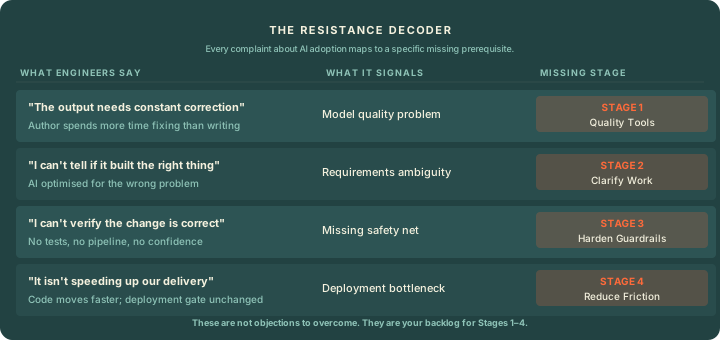
Every specific complaint about AI tools maps to a specific missing prerequisite:
| What engineers say | What it actually signals | Missing stage |
|---|---|---|
| "The output needs constant correction" | Model quality problem | Stage 1: Quality Tools |
| "I can't tell if it built the right thing" | Requirements ambiguity | Stage 2: Clarify Work |
| "I can't verify the change is correct" | Missing safety net | Stage 3: Harden Guardrails |
| "It isn't speeding up our delivery" | Deployment bottleneck | Stage 4: Reduce Friction |
This mapping turns the resistance from noise into signal. A team saying "the AI output needs too much correction" is not blocking progress — they are telling you exactly which part of the foundation is missing. A team saying "we can't verify AI-generated changes" is describing a test coverage gap that would have caused problems without AI too.
Most leaders hear the resistance and ask: "How do we overcome it?" The more useful question is: "Which stage are we at?"
The Five-Stage Sequence
The teams with successful, sustained AI adoption did not overcome resistance. They removed its cause.
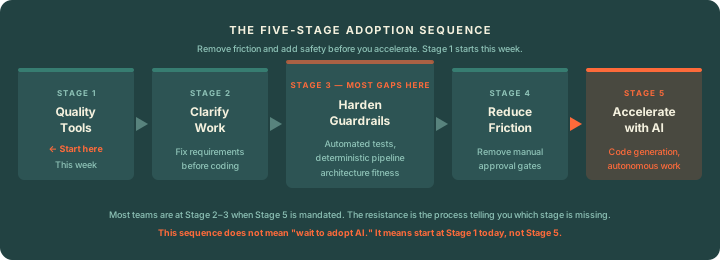
The sequence that consistently works:
Stage 1: Quality Tools. Before using AI for anything, choose models that minimize hallucination and rework. A model with a 20% error rate carries a hidden rework tax on every output. Measure the rework that AI-generated code requires in your codebase. If it consistently exceeds 20% of generated output, the tool is a net negative regardless of its speed.
Stage 2: Clarify Work. Use AI to improve requirements before code is written, not to generate code from vague requirements. Ambiguous requirements are the single largest source of defects across teams at every scale. Use AI to review tickets for gaps, contradictions, and untestable statements before development begins. If AI cannot generate clear test scenarios from a requirement, the requirement is not clear enough for a human either.
Stage 3: Harden Guardrails. Before accelerating code generation, build the safety net. Automated tests covering critical behavior. Deterministic pipelines running on every commit. Architecture fitness checks. Security scanning. The diagnostic question for each guardrail: "If AI generated code that violated this, would our pipeline catch it?" Fix every no before expanding AI use. This is the stage most teams skip — and the stage most adoption resistance is pointing at.
Stage 4: Reduce Delivery Friction. Remove the manual steps and approval gates that limit safe delivery speed. These bottlenecks exist in every team and become the constraint when AI accelerates code generation. If deploying requires a specific person, a specific day, or a runbook, it is a bottleneck that will be exposed when code moves faster.
Stage 5: Accelerate with AI. Now — and only now — expand AI to code generation, refactoring, and autonomous contributions. The guardrails are in place. The pipeline is fast. Requirements are clear. The outcome is deterministic regardless of whether a human or an AI wrote the code.
The critical point: this sequence does not mean "wait to adopt AI." It means adopt AI at Stage 1 today, not Stage 5. Stage 1 starts this week — it means choosing better tools and measuring their rework rate. Stage 2 starts the same week — it means using AI to review requirements for ambiguity before code is written. Both are AI adoption. Neither requires waiting.
Resolving the Tension
The push and the pull are not opponents. They are two sides of the same diagnostic, viewed from different vantage points.
Leadership is right that AI transforms engineering delivery — the data supports it. Engineers are right that their current process is not ready for AI acceleration — their experience supports it. Both sides are describing the same gap from different directions.
The sequence gives both sides the same map.
To leadership: the path to the results you are seeing at competitors runs through Stages 1 to 4. The teams getting 2x throughput built that foundation first. The work to complete those stages is not a delay in AI adoption — it is AI adoption. Start Stage 1 this week. Use the resistance complaints as the backlog for Stages 2, 3, and 4.
To the engineering team: the resistance is accurate, but the conclusion is "fix the process," not "the tools don't work." Map each specific complaint to the stage it points at. Each one is a concrete project with a clear outcome. Fix the nearest stage and the next stage of adoption becomes viable — because the condition that made the tools net-negative gets removed.
Three things to do this week:
-
Audit the complaints. Collect the specific things engineers have said about AI tools in the last 90 days. Use the decoder above to identify which stage each complaint points to. The pattern will tell you where you actually are — more accurately than any assessment tool.
-
Start Stage 1 immediately. Measure the rework rate on AI-generated code over the last 30 days. If you do not have that data, start collecting it today. If rework consistently exceeds 20%, tool selection is the first fix — not process work, not training sessions.
-
Name Stage 3 as the quarter's priority. Hardening the guardrails — test coverage on critical paths, a deterministic pipeline — has value independent of AI adoption. It reduces defects from every source. The teams that complete Stage 3 find that AI adoption accelerates naturally in the following quarter. The tools are finally net-positive on the process they run on.
The Bottom Line
The push and the pull are both correct reads on reality. Leadership pressure for AI adoption reflects real competitive data. Engineering resistance reflects real delivery process gaps. Neither side is wrong. They are in conflict because nobody has named what both are pointing at: a sequence problem.
Read the resistance as a diagnostic. Fix the stages it identifies. Start Stage 1 this week, not Stage 5. The adoption debate resolves itself when the tools start delivering on what the success stories describe — because the process finally supports what the tools require.


