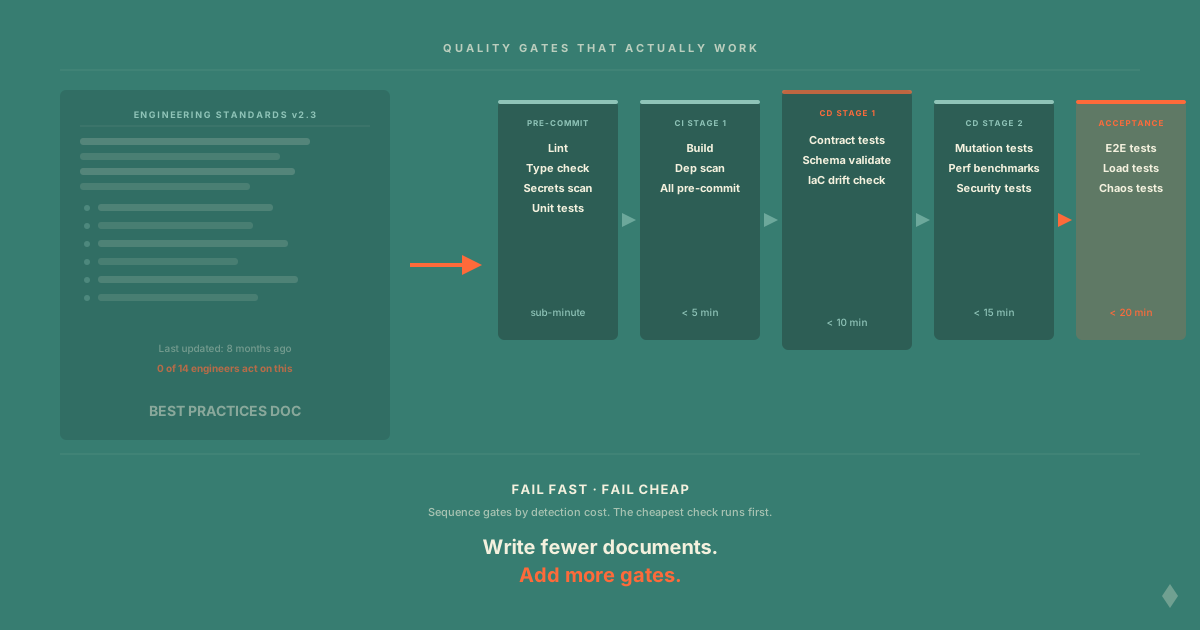
Quality gates work where best practices documents fail because they remove humans from the compliance loop. A document requires engineers to read it, remember it, and apply it consistently under pressure. A gate requires nothing from anyone — the commit either passes or it does not. Sequenced by "fail fast, fail cheap," a complete gate pipeline catches defects at their lowest cost and scales without attention.
We maintained a 14-page engineering standards document. It had sections on code structure, naming conventions, test coverage thresholds, security review checklists, and PR guidelines. A senior engineer spent two weeks writing it. It was thorough and accurate. Within three months, it was referenced in exactly one conversation — when someone onboarded a new hire and remembered it existed.
The document was not the problem. The problem was the theory behind it: that you can scale engineering quality through human compliance with written guidelines.
You cannot.
Why Documents Fail
Three things have to happen every time an engineer commits code for a best practices document to work: they have to remember the document exists, recall the relevant section, and apply it correctly while under deadline pressure.
Think about what "consistently apply all the standards in a 14-page document on every commit" actually means in practice. Across 12 engineers. Across 200 commits per week. Across six months of changing priorities and team turnover. The inconsistency is not a character flaw — it is a property of any process that depends on humans remembering and voluntarily applying rules.
The failure mode is ordinary: working memory has limits, priorities compete, and new engineers never read the document at all. We have seen teams maintain genuinely good standards documentation — and still watch the same defect categories recur sprint after sprint because no automated check enforces them.
The solution is not to stop writing standards documents. It is to understand what each tool can actually do. Documents define intent — architectural principles, coupling strategy, API design guidelines, domain modeling decisions. None of those are machine-verifiable. Gates enforce everything that is: type errors, secrets in code, known vulnerabilities, integration boundary failures. The two are not substitutes. They have different jobs. The failure pattern is expecting a document to do the enforcement job. Automated enforcement does not forget, does not skip steps under pressure, and does not vary by engineer. For enforcing machine-verifiable standards consistently at scale, automation is the only approach that doesn't degrade under cognitive load.
What Quality Gates Actually Do
A quality gate is an automated check that runs on every commit and blocks progression if it fails. The commit either passes or it does not. No human judgment required at execution time. No memory required.
The principle that sequences them: fail fast, fail cheap. Gates that catch the most common defects with the least execution time run first. A linting check catches style issues in under a second. An acceptance test suite takes 20 minutes. You do not wait 20 minutes to discover the code has a formatting error.
That sequencing reflects an economic reality about defects: every pipeline stage a defect survives makes it more expensive to fix. A type error caught at pre-commit takes seconds to correct. The same error surviving to acceptance tests requires reproducing the environment, re-understanding the context, and re-deploying. Surviving to production adds incident response, rollback decisions, and user impact. The cost is not linear — it compounds at each stage. "Fail fast, fail cheap" is not a workflow preference. It is a cost-reduction strategy applied to defect detection.
This is also what makes gates practical rather than theoretically appealing. A pipeline with only slow tests at the end gives engineers 45-minute feedback cycles on simple mistakes. A pipeline sequenced correctly gives sub-second feedback on the cheapest problems and reserves the slow checks for defects that actually require them.
The Gate Sequence
The five pipeline stages below are ordered by feedback speed and detection cost. Each stage adds a layer of verification that the previous stage cannot provide.
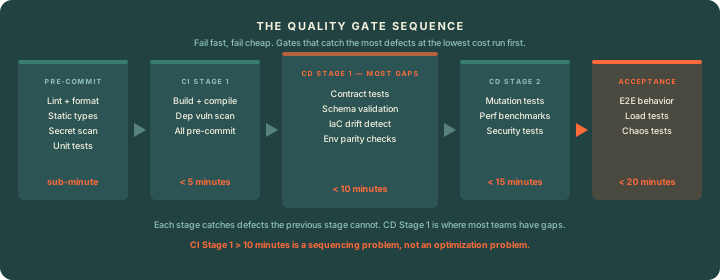
Pre-commit gates run on the developer's machine before code leaves the workstation. Sub-second to sub-minute feedback. These catch linting violations, type errors, secrets in code, SAST injection patterns, and unit test failures before they reach any shared system. Defects caught here cost the least of anything in the pipeline.
CI Stage 1 runs on every commit to trunk: compilation and build, dependency vulnerability scanning, and re-running all pre-commit gates in a clean environment. The timing target — typically five minutes for most backend and frontend stacks, longer for monorepos and compiler-heavy languages — exists for a specific reason: when feedback latency exceeds the time it takes to context-switch to the next task, engineers start batching changes. Batching increases defect density and review complexity simultaneously. The exact number varies by stack. The principle does not.
CD Stage 1 validates integration boundaries: contract tests at every service boundary, schema migration validation, and infrastructure-as-code drift detection. These catch the class of defects unit tests cannot — the assumptions two services make about each other. A passing unit test suite tells you each component works in isolation. Contract tests tell you the components will work together.
CD Stage 2 runs broader verification in parallel: performance benchmarks against baseline, security integration tests for authentication and authorization paths, and — for teams with a mature test suite already in place — mutation testing to surface tests that pass without actually verifying behavior. Mutation testing carries real runtime cost and is not an early gate to add. It belongs here once a strong unit test suite exists and you need confidence in what it is actually asserting, not while you are still establishing the baseline.
Acceptance tests validate user-facing behavior in a production-like environment. These are the most expensive checks — up to 20 minutes — and run after the cheaper gates have already eliminated the common defect classes. The sequencing is what makes them effective: by the time code reaches acceptance tests, every cheaper check has already passed. They become a signal about user-facing behavior, not a catch-all for everything the earlier gates missed.
The Pre-Feature Baseline
Before gate sequencing matters, there is a more immediate question: which gates do you have right now?
Most teams have some gates. In our experience, very few have the nine that form the baseline for production systems with multiple contributors and external dependencies. A solo internal tool carries different risk than a multi-team service under live traffic. But for systems where multiple engineers commit regularly and reliability matters, these are the most common baseline gates — below which defects accumulate faster than the team can detect them.
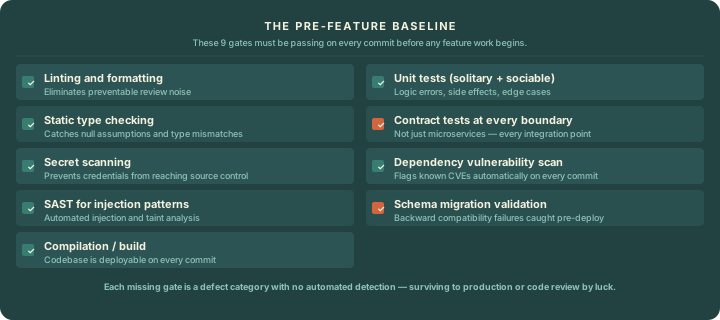
The nine Pre-Feature gates:
- Linting and formatting — eliminates an entire category of preventable review noise
- Static type checking — catches null/missing data assumptions and type mismatches before runtime
- Secret scanning — prevents credentials and API keys from reaching source control
- SAST for injection patterns — catches injection vulnerabilities and taint analysis automatically
- Compilation / build — guarantees the codebase is in a deployable state on every commit
- Unit tests — solitary and sociable tests covering logic errors, side effects, and edge cases
- Contract tests — at every integration boundary, not just between microservices
- Dependency vulnerability scan — flags known CVEs in dependencies automatically
- Schema migration validation — catches backward compatibility failures before they reach production
Without these passing on every commit, each missing gate is a defect category with no automated detection point. Defects in that category survive to production, or survive to code review — where a human catches them by luck, inconsistently, under time pressure. Which is the problem we started with.
The practical effect on review load is visible and immediate. Teams without a complete Pre-Feature baseline send reviewers code that may have obvious type errors, use deprecated dependencies with known CVEs, or include secrets in configuration. Reviewers compensate by checking these things manually. This is precisely the pattern that standards documents tried and failed to solve — now happening in the PR thread instead of the Confluence page.
Quality gates remove that class of mechanical work from review. They do not remove the need for engineers who can assess architectural tradeoffs, catch coupling problems, or recognize when code solves the wrong problem. Those remain human work. The goal is a reviewer who never has to comment on a type error — and has full attention for the design decision that no linter can see.
Starting This Week
Three concrete steps:
Audit against the Pre-Feature baseline. Open your pipeline configuration and check each of the nine gates. Mark which are active and which are missing. The gaps in that list are the priority — not because the CD stages do not matter, but because you cannot reliably build on a foundation with holes in it.
Add the first missing gate. Pick the highest-impact gap from your audit. Secret scanning and SAST are almost always the highest-severity if absent — they catch defect classes reviewers rarely catch consistently, and they are fast to add. Add one gate, verify it runs on every commit to trunk, and measure how many issues it flags in the first week.
Check your CI Stage 1 feedback latency. The target varies by stack — five minutes for typical backends, longer for large monorepos or native builds — but the principle is consistent: if engineers are context-switching to the next task while waiting for CI, the feedback loop is already broken. Check what is running in that stage and whether any of it belongs in a later stage. When pipelines are slow, the fix is almost always reclassification of gates to a later stage, not optimization of the existing ones.
The sequence does not need to be complete before it is useful. Each gate added is a defect class that no longer escapes to review or production. The document it replaces does not need to be updated when it gets outdated.
The Bottom Line
Best practices documents describe the quality your team aspires to. Quality gates enforce the quality your team actually ships. Documents require humans to consistently remember and apply standards under pressure. Gates remove the human from the compliance loop entirely.
The sequence matters: fastest and cheapest gates run first, most expensive gates run last. The Pre-Feature baseline matters: for production systems with multiple contributors, nine specific gates must exist and pass before feature work begins. And the feedback latency matters: when CI Stage 1 takes longer than engineers can stay focused on the same task, the loop is already broken — regardless of what it checks.
Write fewer standards documents. Add more gates.


