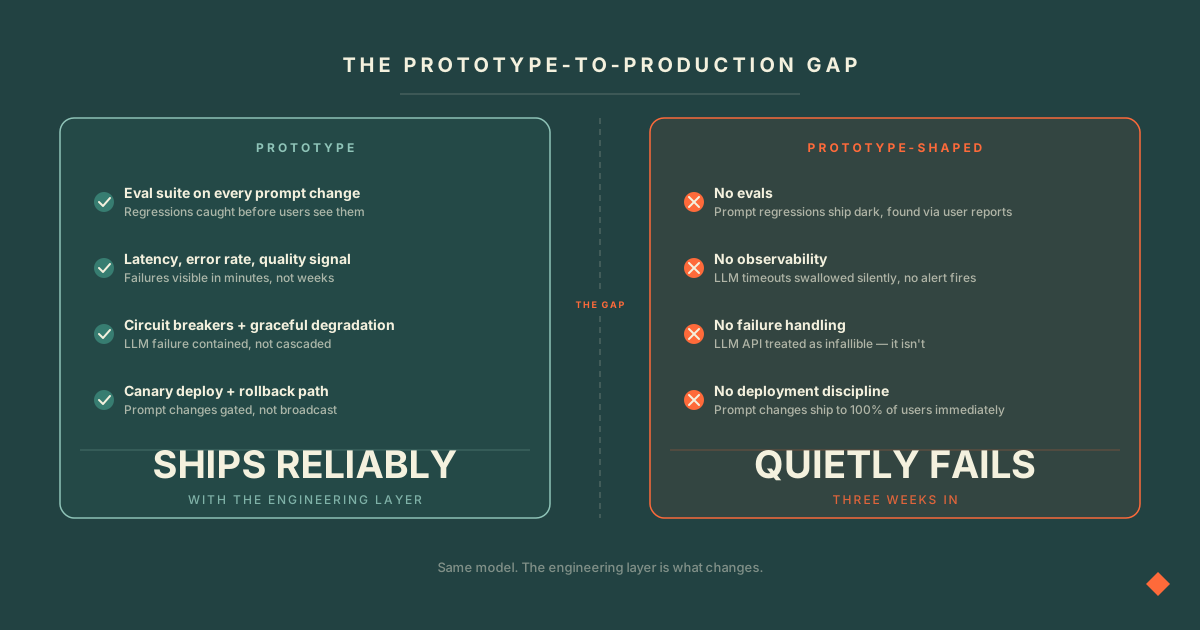
Most AI projects fail in production not because the model is wrong but because the engineering around the model is prototype-shaped: no evals to detect regressions, no observability to diagnose failures, no circuit breakers for LLM timeouts, and no deployment discipline for prompt changes. The gap between a working demo and a reliable production system is an engineering gap — and it has the same solution as every other engineering gap: the same practices, applied to a new medium.
The demo runs perfectly. The stakeholders are impressed. The prototype passes every test you run on it.
Three weeks after you ship it to production, it is quietly failing. The model is returning malformed JSON on 3% of requests. A prompt change two sprints ago silently degraded the output quality for edge cases nobody tested. The LLM API is timing out under load, and your error handling swallows the exception and returns an empty response instead. Users are not reporting failures — they are just stopping.
You have no dashboard for this. You have no regression suite for it. You have no alert for it. You discover it in a support ticket six weeks later, and by then the problem has compounded.
This is not an AI problem. It is an engineering problem. And it is the most predictable failure mode in the industry right now.
The Demo Is Not a Lie — The Gap Is Real
AI prototypes genuinely work. The model is capable, the prompt is well-crafted, the response is impressive. None of that is theatre. What the prototype does not have is the engineering layer that turns a capable-in-a-controlled-environment system into a reliable-in-production one.
That layer does not come for free with the model. It does not come from a better prompt. It is not a configuration option in the LLM provider's dashboard. It is engineering work — the same engineering work that has always been required to take any system from "works on my machine" to "works at 3 AM on a Tuesday when load spikes and the API has a partial outage."
The gap kills most AI projects not because the teams are incompetent but because the prototype phase optimises for the wrong thing. The goal of a prototype is a convincing demo. The goal of a production system is reliable operation under conditions the demo never modelled. Optimising for the first and then shipping gives you something that looks production-ready and behaves prototype-shaped.
Gartner estimated in 2024 that the majority of AI pilot projects fail to reach production or are abandoned within twelve months of deployment. The reason is not model quality. The reason is the engineering gap.
The Four Failure Modes Nobody Talks About
When we audit AI systems that failed in production, the same four gaps appear almost every time. None of them are exotic.
1. No evals — the prototype has no regression suite.
A prototype is tested by running it and looking at the output. If the output looks good, it ships. This is the equivalent of testing software by running it and watching the screen — it would catch egregious failures and miss everything subtle.
Prompt regressions are the AI equivalent of a logic bug introduced by a refactor. A change to the prompt — even a small one, adding a sentence, adjusting the tone instruction — can silently change the model's behaviour for specific input patterns. There is no test to catch this because nobody wrote evals.
Evals are the acceptance test suite for model behaviour: a structured set of input/expected-output pairs that runs automatically whenever the prompt, the model version, or the context changes. Without them, every prompt change ships dark. You find out it regressed when a user tells you.
2. No observability — failures are invisible.
Production AI systems fail in ways that are easy to miss if you are only watching traditional metrics. The model times out: your error handling returns an empty string instead of an error, the user sees a blank result, no exception is logged. The model returns valid JSON with a hallucinated field name: your downstream parser fails silently, the feature degrades, nobody notices for a week.
Most AI prototypes ship with zero model-specific instrumentation. No latency histogram per call. No token count tracking. No quality signal from the response. No alert on the error rate for LLM calls specifically.
Without observability, you are operating blind. You know the system is running — the health check passes — but you do not know whether it is producing good outputs. The difference between a system that is up and a system that is working correctly is invisible without the right signals.
3. Brittle failure handling — the LLM is treated as infallible.
Every production system that calls an external API handles failures: timeouts, rate limits, unexpected response formats, partial outages. The LLM API has all of these failure modes and several additional ones unique to probabilistic systems: degraded output quality under load, response format drift between model versions, context length errors when inputs grow, and safety filter rejections that look like errors but are intentional.
Prototype code handles none of this. The API call either works or it throws an uncaught exception. There is no circuit breaker, no retry with backoff, no graceful degradation to a simpler code path when the model is unavailable, no response schema validation before the output is used.
The same rigour you apply to a payment API — error handling, retry logic, contract testing the response schema, alerting on elevated error rates — applies to the LLM API. The model is a third-party dependency with a non-deterministic output. It deserves the same engineering respect as Stripe.
4. No deployment discipline — prompt changes ship to 100% of traffic.
In a standard software pipeline, a risky change goes through a review, a test suite, a staging environment, and a canary deployment. If the canary metrics look bad, the rollout stops. Most AI prototypes have none of this for prompt changes.
A prompt is code. It determines the behaviour of the system for every user. Changing it and shipping it directly to 100% of traffic is the equivalent of deploying a code change without tests and without a feature flag. If it regresses, you have no rollback path except manually reverting the prompt and redeploying — and you probably will not notice for hours.
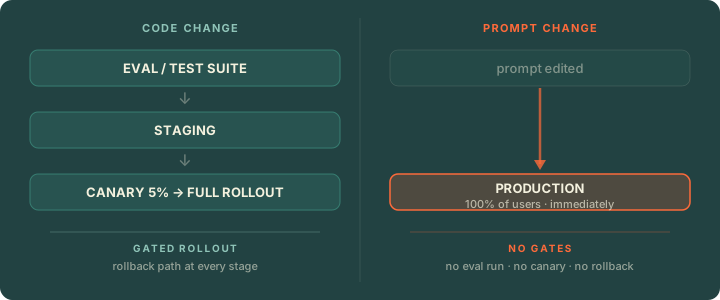
Figure 1: The deployment discipline gap. A code change earns its way to production. A prompt change in most AI systems is shipped directly — same production blast radius, none of the gates.
The Fix: Same Practices, New Medium
None of the practices that close this gap are AI-specific. They are the engineering practices that have always separated prototype-quality systems from production-quality ones. What changes is the medium of application.
Write evals before you ship, not after.
Evals are acceptance tests for model behaviour. Write them the same way you write acceptance tests for any feature: before implementation, in terms of the user-facing behaviour, against the specification rather than the implementation.
A minimum eval suite before a first production deployment: five to ten representative inputs covering the happy path, three to five adversarial inputs covering edge cases the model struggles with, and two to three regression inputs from any failures you have already seen. Run this suite on every prompt change, every model version update, and every context change. If the suite regresses, the deployment stops — the same way a failing test suite stops a code deployment.
The eval suite is not complete on day one. It grows with every production failure. Every bug that escapes to users becomes a new eval. The suite is the regression memory of the system.
Instrument every model call from day one.
Three signals, minimum, on every LLM call: latency (milliseconds), token count (input and output), and an outcome signal (did the response parse correctly, did it pass format validation, did the downstream consumer succeed). Alert on elevated latency, elevated error rate, and anomalous token counts.
Build a simple quality dashboard before the first production deployment. It does not have to be sophisticated — a Grafana panel showing error rate and latency per model call is enough to detect most production failures within minutes rather than weeks.
Apply circuit breakers and graceful degradation to every LLM call.
Define the failure budget for each model call: what is the acceptable timeout, what is the acceptable error rate, what does the system do when the budget is exceeded. For most use cases, the right degradation is a cached response, a deterministic fallback, or a user-facing message that names the failure instead of silently producing empty output.
Validate the response schema before using it. If the model returns JSON, parse and validate it against a schema before any downstream code touches the fields. A response format drift between model versions should produce a validation error with a clear message, not a null pointer exception three layers deep in the call stack.
Gate prompt changes through an eval run and a canary.
Treat the prompt as a versioned artifact — the same way you treat a dependency version. When you change the prompt, run the eval suite against the new version before it touches production. If the suite passes, deploy to a canary: 5-10% of traffic, with the quality signal you built in step two as the canary metric. If the metric moves in the wrong direction in the first hour, roll back.
This is not a complex pipeline. It is a two-step gate — eval run, then canary — that catches most prompt regressions before they reach the full user base.
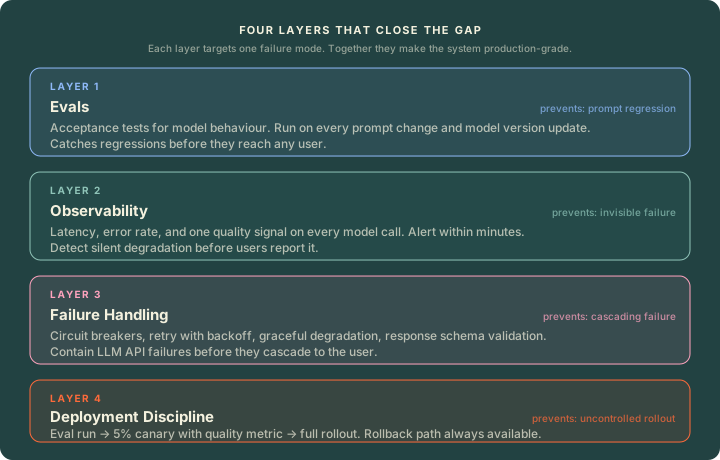
Figure 2: The four engineering layers that close the prototype-to-production gap. Evals detect regressions. Observability makes failures visible. Failure handling contains blast radius. Deployment discipline controls rollout risk.
What to Do Before the Next AI Ship
Four Monday-morning steps that change the trajectory of an AI project still in prototype phase:
-
Audit your current eval coverage. How many input/output pairs does your system have automated evaluations for? If the answer is zero, write five today — the happy path and two edge cases from the last failure you remember.
-
Add three metrics to your model calls. Latency, error rate, and one application-level quality signal. Alert if error rate exceeds 2% in any five-minute window.
-
Add one circuit breaker. Pick the highest-stakes LLM call in your system. Add a timeout, a retry with backoff, and a graceful fallback for when the call fails. This takes two hours and prevents a class of production incidents that currently has no resolution path except "wait for the API to recover."
-
Version your prompt. Store the current prompt in version control if it is not already. Tag the version you shipped. The next time you change it, run your eval suite before deploying.
None of these are big projects. Each one closes a specific failure mode that is currently open. Together they move the system from prototype-shaped to production-aware — without a rewrite, without a platform migration, without a sprint-long initiative.
The Bottom Line
The demo works. The prototype impresses. The production system quietly fails three weeks later. This is the most predictable failure mode in AI engineering right now — and it is entirely avoidable.
The gap between a prototype and a production AI system is not a model gap. It is an engineering gap: missing evals, missing observability, missing failure handling, missing deployment discipline. The solution is not a better model. It is the same engineering rigour that has always made production systems reliable, applied to a new medium where the component being tested is probabilistic instead of deterministic.
The practices are known. The tools exist. The only thing that changes is whether you apply them before the prototype ships or after the production failure that makes you realise you should have.


