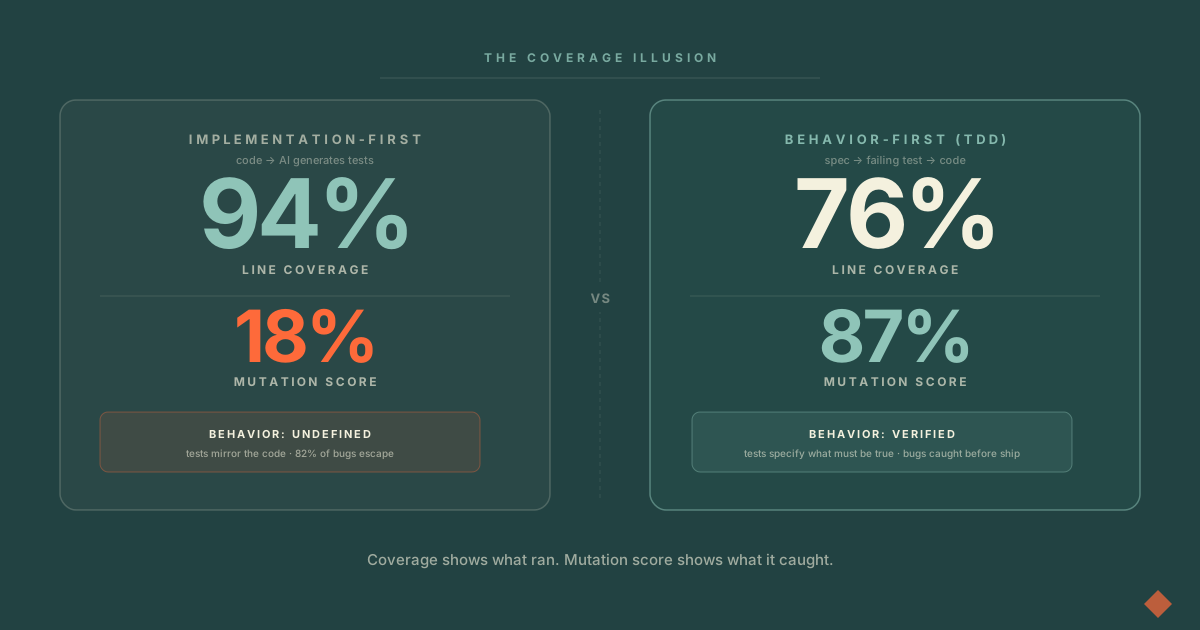
AI-generated test suites commonly achieve high coverage while carrying low mutation scores — because tests written after implementation mirror the code they observe rather than specify the behavior it must produce. Coverage measures line execution. Mutation score measures whether a test would catch a behavioral bug. They are different signals, and most pipelines gate on the wrong one. The fix is behavioral spec before implementation: TDD mode for AI means you write the failing test, then AI writes the code — not the reverse.
A test suite that looks professional is not the same as one that works. AI can generate a complete suite — descriptive test names, nested describe blocks, multiple assertions per function, 94% line coverage — in the same session it writes the implementation. CI stays green. The reviewer sees a healthy suite and approves the PR.
The gap is behavioral. Tests written alongside or after implementation verify that the code does what it does. They cannot verify that what it does is what it should — because the behavioral spec was never defined before the code existed. The implementation is already there, and the tests learn from it.
This is not an edge case. A 2026 study presented at the International Conference on Mining Software Repositories (MSR '26) analysed 2,232 commits containing test-related changes across real-world repositories. AI agents authored 16.4% of all commits adding tests — a significant and growing share of every organization's test suite, generated by a process that has no mechanism for defining what behavior looks like before producing code.
The Coverage Number Was Never the Right Signal
Coverage measures whether a line of code executed during a test run. Mutation score measures whether a test would catch a bug introduced into that line. These are different measurements of different things, and most pipelines gate on the wrong one.
AI-generated tests achieve coverage comparable to human-written tests. The MSR '26 study found AI-generated tests feature longer code, higher assertion density, and lower cyclomatic complexity. All of that reads like quality. None of it is quality — it is structural complexity, which is straightforward to generate, and it is being mistaken for behavioral coverage, which requires knowing what correct looks like before writing the test.
A test that calls calculateDiscount(100, 0.1) without asserting on the return value covers the function completely. The coverage tool records the lines as executed. The test catches zero bugs. A mutation that changes the discount calculation to return the wrong number will survive it.
The question coverage never asks: if I introduced a behavioral bug here, would this test catch it?
What AI-Generated Tests Actually Do
When a test is written after the implementation, it has one reference point: the code that already exists. The natural path — for a human writing retroactively, or for an AI writing automatically — is to observe what the code does and assert on it.
This is the retroactive coverage sprint anti-pattern running at machine speed. A developer writing tests for code they did not write, against behavior they do not fully understand, encodes current behavior as correct whether it is correct or not. When a bug is later found in that code, the test still passes — it asserts on the buggy behavior. AI performs this operation on every commit where it generates both implementation and tests in the same session, without any signal that something is wrong.
The structural signature is consistent with research findings: AI-generated tests feature more assertions than human-written tests. More assertions sounds like more rigor. The problem is what the assertions verify. Assertions that check implementation state — that a method was called, that a value matches what the code currently returns, that a field equals what the code currently sets — are not behavioral assertions. They confirm that the code does what it does right now. They survive any mutation that does not change the exact implementation path they observed at generation time.
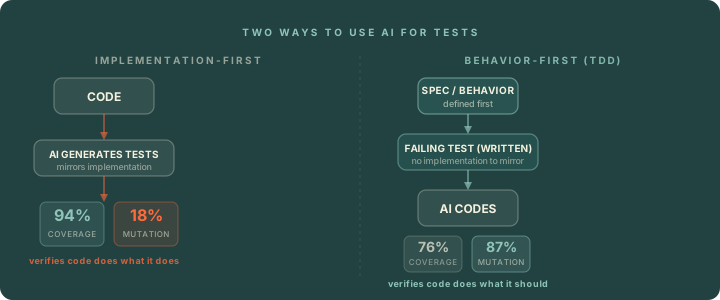
Figure 1: Implementation-first produces tests that mirror the code. Behavior-first produces tests that specify what the code must do.
The Gap Is Invisible Until Mutation Testing Runs
A mutation testing tool makes small, targeted changes to production code — flipping a boolean, changing > to >=, removing a return statement — and checks whether any test detects the change. A surviving mutant is a real gap: the code changed, all tests still passed.
A test suite with 100% line coverage and a 4% mutation score executes every line and misses 96% of potential behavioral failures. This combination is not theoretical. It is the predictable output of tests written to mirror an implementation rather than specify behavior.
The link between AI test generation and low mutation scores is direct and measurable. Research shows that when AI tools are given explicit mutation feedback — shown which mutants survived and asked to generate tests that kill them — mutation scores improve from 70% to 78%. The tool is capable of closing the gap. But it closes the gap only when mutation testing is running and feeding results back. Most pipelines gate on coverage and never run mutation testing at all.
The gap does not appear on the CI dashboard. It is not visible in the PR. It becomes visible the first time a behavioral change — a calculation boundary, a permission rule, a response format — ships without detection because every test in the suite still passed.
What This Means for Your Coverage Gate
Coverage as a CI gate accelerates the problem rather than containing it. AI-assisted development can push a codebase from 30% to 90% coverage in a single session. If coverage is the gate, AI passes the gate — every time, without the gate ever asking what the tests are verifying.
Teams that set coverage targets — 80%, 90%, sometimes 100% — create a system AI is perfectly positioned to satisfy and perfectly positioned to hollow out. Test count rises. Assertion count rises. Coverage percentage rises. Mutation score, which nobody is tracking, stays low because the tests were generated to match an implementation, not to specify and verify behavior.
The coverage mandate anti-pattern predates AI. Teams have always found ways to write tests that hit numbers without catching bugs: assertion-free tests, getter/setter farms, one-assertion integration tests that touch hundreds of lines without validating any of them. AI does not create this incentive. It removes the friction that previously slowed down the gaming of it.
The Fix: Behavior Comes Before Code
The ordering of test and implementation is everything.
A test written before the implementation has one reference point: the specification. It must describe what correct behavior looks like — what inputs produce what outputs, under what conditions, at what boundaries — before any code exists to observe. That is the behavioral assertion. It cannot mirror an implementation that does not yet exist.
This is the mechanism TDD enforces, and why AI used in TDD mode produces fundamentally different test suites than AI used in generate-and-test mode. When the developer writes the failing behavioral test first — even a single assertion for what the function must return for a specific input — and then asks AI to implement against it, the test was written against a spec, not an observation. The implementation will be generated. The test cannot mirror what did not yet exist when it was written.
The practical shift is not "stop using AI for tests." It is: write the failing test, then ask AI to implement. Use AI to generate code against tests you specified, not to generate tests against code it just wrote.
Two diagnostics for any AI-heavy test suite:
Run mutation testing on the modules where AI generated tests alongside implementation. Compare the mutation score to modules with human-written or TDD-written tests. A significant gap is a structural signal — the tests were produced by a process that cannot write behavioral assertions before it has behavior to observe.
For ten surviving mutants, find the test that should have caught each one. Does that test exist? If it exists but passed the mutation, what is it asserting on? If the test asserts that the function returned the value the implementation currently returns, it cannot catch a mutation that changes how the function computes that value — only one that changes the specific output the test observed.
The Bottom Line
AI-generated test suites can achieve high coverage, pass CI, and look professionally written while verifying almost nothing about intended behavior. The mechanism is straightforward: tests written alongside implementation mirror the implementation. Coverage measures execution. Mutation score measures behavioral verification. They are different signals. Most pipelines track only the first.
The teams that close this gap are not the ones that stop using AI for tests. They are the ones that define behavioral correctness before implementation begins — and use mutation score, not coverage percentage, as the honest signal of whether the test suite has actually captured what the code must do.


