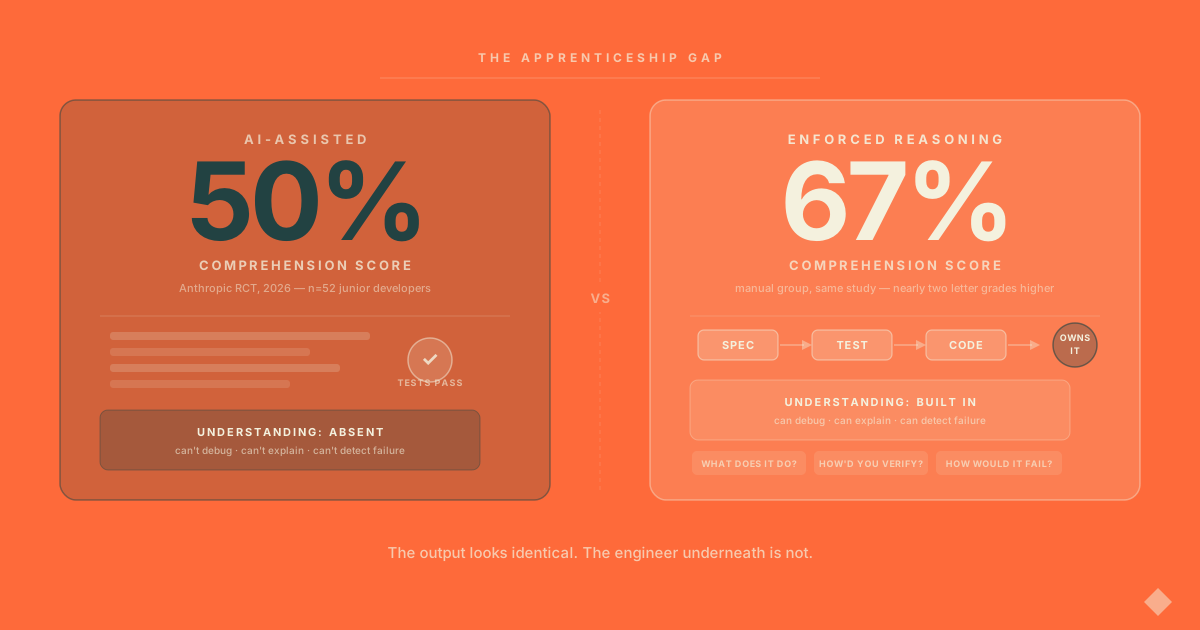
AI coding tools let junior developers produce senior-looking output without building the reasoning behind it. A 2026 Anthropic RCT found a 17-point comprehension gap between AI-assisted and manually coding juniors — but the deeper problem is organizational: most companies already rewarded shipping over understanding before AI arrived. AI didn't create shallow engineering cultures. It accelerated them. The fix is enforcing the reasoning step before implementation begins, not removing AI from the workflow.
Code is now the least honest signal of engineering capability we have.
A junior developer with a good AI coding assistant can produce output that is syntactically clean, architecturally structured, and professionally formatted — indistinguishable from the work of someone with five years of experience. The tests pass. The reviewer approves it. It ships.
Three weeks later it is a production incident. When someone asks the developer what the code was supposed to do and how they verified it, the answer is a long pause. Not because they aren't capable. Because they never had to know. The AI generated the implementation and the tests. Both were green. The understanding was never part of the workflow.
Call it Potemkin seniority: the facade of senior output over a gap where the reasoning should be.
The Illusion Is Working Perfectly
Clutch surveyed 800 software professionals in 2025 and found that 59% of developers regularly use AI-generated code they do not fully understand — not occasionally, when under deadline pressure, but as a default workflow.
This is not a failure of individual developers. They are responding rationally to the incentive structure around them. Most engineering organisations measure velocity: tickets closed, PRs merged, features demoed. AI improves all of those numbers. Understanding — the ability to debug, explain trade-offs, detect failure — doesn't appear on any dashboard.
The telltale sign is this: when a bug appears in AI-generated code, the developer who committed it cannot describe what the change was supposed to do or what acceptance criteria it was verified against. Not because they forgot. Because they never knew. The AI knew. The developer ran the tests, saw green, and shipped.
This is worth being precise about. The problem is not universal — teams with strong review culture and deliberate onboarding do catch this. Some developers use AI well, asking it to explain reasoning rather than just generate output, and genuinely deepen their understanding in the process. The issue is that nothing in the default workflow requires it, and the incentives actively favour skipping it.
What the Data Shows
In early 2026, Anthropic published a controlled trial with 52 junior developers learning a new Python library. Half used AI assistance; half coded manually. The AI-assisted group finished about two minutes faster — not statistically significant. Then came the comprehension quiz.
The manual group scored 67%. The AI-assisted group scored 50%. Developers who had fully delegated code generation to AI scored below 40%. Developers who used AI to ask conceptual questions — why, not just what — scored above 65%.
The tool was not the problem. The mode of use was the problem. And nothing in the average team's workflow distinguishes between the two modes.
The experienced-developer picture is equally instructive. A July 2025 MIT/NBER study found that developers working on unfamiliar codebases were 19% slower when using AI tools. Before the study, those developers predicted AI would make them 24% faster. After the experience, they still believed they had been 20% faster — a gap of nearly 40 points between perceived and actual productivity.
Seniors slow down because they have the mental models to know when something is wrong. They stop to verify. Juniors do not yet have those models, so they do not stop. The result is higher apparent throughput and lower actual comprehension — both moving in the wrong direction at once.
The Apprenticeship Was the Curriculum
The traditional apprenticeship model was slow and often inefficient. It was also how understanding was transmitted.
Juniors learned by hitting walls — debugging failures they had introduced, tracing error messages back to root causes, working alongside people who could name what they were seeing and explain why a trade-off had been made. The struggle was not incidental to the learning. It was the mechanism.
AI removed the friction. Friction was the curriculum.
GitClear analyzed 211 million changed lines across repositories from 2020 to 2024. Refactoring activity dropped from 25% of changed lines in 2021 to under 10% in 2024. Code cloning rose from 8.3% to 12.3%. Churn — code revised within two weeks of commit — rose from 3.1% to 5.7%. This is the code-level signature of fast generation without comprehension: copy more, refactor less, fix more of what just shipped.
When juniors skip the apprenticeship because AI provides the shortcut, and seniors are already stretched reviewing AI-generated code at volumes they weren't designed to handle, the transmission of craft stops. The oral tradition breaks — not because nobody wants to transfer knowledge, but because there is no longer a mechanism through which it flows.
The Organizational Incentive Nobody Is Talking About
The comprehension gap is a developer problem on the surface. It is an organizational economics problem underneath.
Most companies were already optimizing for output theater before AI arrived. Velocity metrics, demo cadence, ticket throughput — these are what get reported to leadership and what shape team incentives. The slowdown required for genuine understanding — writing the spec before the code, asking why before generating what, running mutation tests to verify behavior — all of it looks like friction on a burndown chart.
AI did not create engineering cultures that reward shipping over understanding. It found those cultures already in place and made the dynamic faster.
This matters for how the problem gets fixed. Telling developers to understand their AI-generated code does not work when the system around them continues to measure only whether the code shipped. The fix has to be structural — either the workflow enforces the reasoning step, or the incentives do. Relying on individual discipline inside a system optimized for speed is not a strategy.
Entry-level tech hiring dropped 25% year-over-year in 2024. When companies adopt generative AI, junior developer employment drops approximately 9-10% within six quarters. 54% of engineering leaders plan to hire fewer junior developers. Each of these decisions looks rational in isolation. Collectively, they hollow out the pipeline that produces mid-level engineers — the people who eventually become the seniors capable of catching what AI gets wrong.
Stack Overflow's December 2025 analysis drew the right historical parallel: after the 2008 recession, companies stopped hiring juniors en masse. By 2012, engineers with three to five years of experience had become scarce — because they had never been hired as juniors during the freeze. The same dynamic is forming now across thousands of organizations simultaneously.
The Fix: Enforce the Reasoning Step
The answer is not removing AI from developer workflows. That is neither practical nor the point.
The answer is making the reasoning step — defining what correct behavior looks like before any implementation begins — structurally non-optional. TDD is one mechanism for this. Spec-first ticketing is another. Architecture fitness functions are a third. The specific tool matters less than the principle: humans must define what the code should do before AI generates it. The understanding has to come first, or it does not come at all.
The ownership test. Before AI-generated code is committed, the developer should be able to answer three questions: What does this change do? What acceptance criteria did I verify it against? How would I detect if it were wrong in production? If the answers are not there, the code is not ready — regardless of whether the tests pass. This is not a review heuristic. It is a gate that forces the reasoning AI bypassed.
Mutation testing as the diagnostic. AI-generated test suites written alongside the implementation tend to verify the implementation, not the behavior. Running mutation testing against a module makes this gap visible without requiring a judgment call. The score does the talking. Teams that run this consistently find it is a more honest signal of comprehension than coverage percentage.
Measure rework rate by commit type. If you are tracking churn or rework at the repo level, split it between AI-assisted and manually written commits. The difference is usually significant — not because AI generates worse code, but because developers who do not understand what they generated are slower to detect that it is wrong.
The Bottom Line
The output of AI-assisted development can look indistinguishable from senior engineering work. The comprehension behind it often is not.
This is a harder problem than it appears because the incentives that produced it — measuring shipping over understanding, rewarding velocity over reasoning — were already present before AI arrived. AI made those incentives faster. Fixing the symptom without addressing the organizational economics produces developers who know they are supposed to understand the code, but are still measured on whether it ships.
The teams that build durable engineering capability through this period are the ones that make comprehension a structural requirement, not a personal virtue. The reasoning step has to happen before the keyboard. Everything else is downstream of that.


