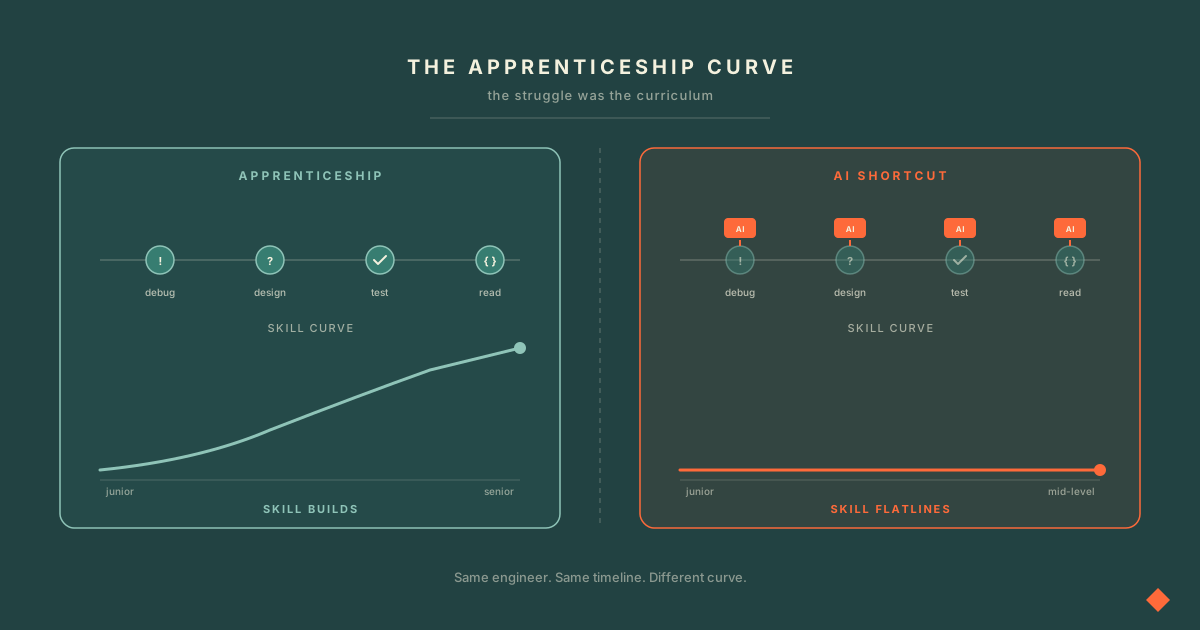
AI tools are shortcutting the four learning loops that produce senior engineers — debugging, design, test writing, and code reading at depth. Juniors with an agent in their pocket ship more code and learn less from it. The output looks competent; the underlying skill never develops. The cost lands eighteen to twenty-four months out, when today's juniors are the mid-levels and the team's senior bench has not been built. The fix is not banning AI. It is rebuilding the learning structures AI bypasses, deliberately and on purpose.
A mid-level engineer in 2027 cannot debug a production outage without their agent.
The agent is down. The on-call rotation lands on them. They open the logs, they see the stack trace, they wait. The pattern-recognition reflex that a 2017 mid-level developed by spending two hundred hours on similar stack traces never developed for them. They never had to. They have always asked the agent first.
This is the engineer your team is building right now. Not because they are lazy, not because they are unintelligent. Because the apprenticeship curve that turns juniors into seniors has been quietly severed, and almost no team is measuring it.
AI is not making your junior engineers slower. It is making them more productive at the work that does not build them, and worse at the work that does.
The Apprenticeship Curve Was a Skill Factory
The way senior engineers were made, until roughly 2023, was deeply boring and entirely effective.
A junior would hit a bug. They would stare at the stack trace, fail to read it correctly the first time, fail to read it correctly the second time, and slowly, over twenty or thirty similar incidents across two years, develop the pattern-recognition that lets a senior glance at a stack trace and know what is wrong before they have finished the first line.
A junior would design a function. They would pick the obvious data structure, hit its limitations a week later, refactor it, hit different limitations, refactor again, and slowly, over a hundred similar choices, develop the design judgment that lets a senior pick the right structure on the first attempt.
A junior would write a test. The test would pass for the wrong reason. The bug would ship. The retro would name the missing assertion. The next test would be slightly better. After two hundred tests, the junior would write tests that asserted the behaviour rather than the implementation — the difference between a test that catches bugs and a test that catches refactors.
None of these loops were efficient. All of them were the point. The struggle was the curriculum.
What AI Removed Was the Struggle
A junior in 2026 with an agent in their pocket experiences none of these loops in the same way.
The debugging loop is shortcut. The agent reads the stack trace before the junior does. The agent suggests the fix. The junior accepts. The pattern-recognition reflex that requires hundreds of unaided diagnoses does not build because the junior never has to diagnose unaided. They have, in fairness, fixed the bug. They have, in less fairness, not learned anything that will help them fix the next one without the agent's help.
The design loop is shortcut. The agent picks the data structure before the junior considers alternatives. "Use a hash map here" arrives as a finished recommendation, not as the output of a tradeoff conversation. The junior types the hash map. The code works. The junior has not, in the process, formed the mental model of "when does a hash map fail" — because they did not pick the hash map themselves, they did not weigh it against a sorted set, they did not justify the choice.
The test-writing loop is shortcut. The agent generates the test from the implementation it just generated. The test passes. The junior moves on. They have not asked "what would this test prove if I had not seen the implementation?" — because they have always seen the implementation, and the test has always passed. The discipline of writing tests against intent rather than against code is not in their toolkit.
The code-reading loop is shortcut. The agent summarises the file before the junior reads it. The summary is plausible. The junior trusts it and gets on with their task. The deep-reading muscle that turns into architectural intuition — the kind that lets a senior open an unfamiliar codebase and orient in thirty minutes — does not develop because the junior has never had to read a codebase the slow way.
Each shortcut is rational in the moment. The PR gets merged. The bug gets fixed. The test gets written. The work gets shipped. The junior looks productive on every dashboard you have.
The loops that produce seniors are silent, and they are no longer running.
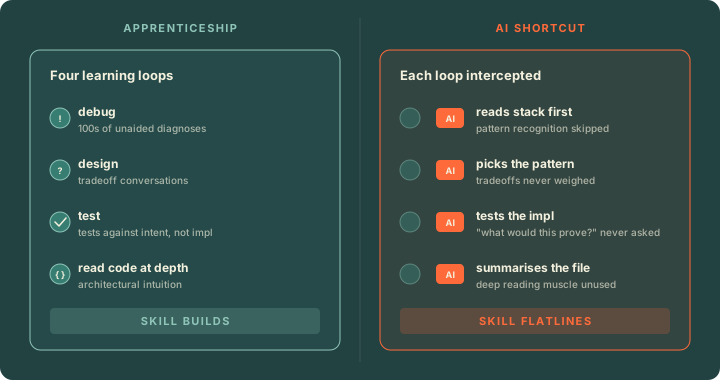
Figure 1: The apprenticeship curve. The struggle was the curriculum. When the agent answers the question before the engineer forms it, the skill the struggle was producing does not develop.
The Time Bomb Lands in 18 to 24 Months
The reason this pattern is hard to address is that the cost is delayed.
A junior engineer in 2026 looks fine. Their PRs land. Their tickets close. The senior-on-call still handles the hard problems, and the junior contributes confidently to the work that AI can scaffold for them. The dashboards show throughput up. The retros do not flag a problem because there is no problem yet.
Eighteen to twenty-four months from now, two things happen at once. The junior is promoted to mid-level. The senior who was carrying the hard problems leaves, retires, or moves to a different team. The mid-level who was supposed to be the next senior is the person staring at the stack trace at 2 AM.
They have shipped a thousand PRs. They have closed a thousand tickets. They cannot diagnose the failure without their agent because the agent is down, the API is failing, the context is novel — and the pattern-recognition reflex that should have been built by a thousand unaided diagnoses has not been built.
This is not a hypothetical. We are starting to see it in teams that aggressively adopted AI tooling in 2023-2024. The senior bench is thinner than expected. The mid-levels who should have been growing into seniors plateau because the substrate the next level requires is missing. Hiring externally is expensive and slow. Rebuilding the pipeline internally takes years.
The math is brutal. AI tools captured short-term throughput gains. They did so by quietly drawing down the team's long-term capability. Most leadership teams have not measured the second number, and most boards have not asked about it.
The Fix Is Not Less AI — It Is Different AI Usage
The instinct to ban AI for junior engineers is lazy contrarianism. Juniors who cannot use AI tools will be uncompetitive in five years; the industry has moved on. The fix is structural — preserve the learning loops AI bypasses, on purpose, with explicit practices.
Three practices we have seen work in production teams.
No-AI fundamentals time. A few hours each week, every junior is given a problem they must reason about without an agent. A small algorithm, a tricky debug, a design exercise. The senior is available for questions — but the questions have to be specific, have to articulate what the junior has tried, and have to come after genuine effort. This is the same structure medical residents have for unaided diagnosis. Without it, the reflex never builds.
Defend-the-design code review. Author must explain why each non-trivial choice is right, what the alternatives were, what tradeoff was made. "The AI suggested it" is not an accepted defense. If the junior cannot articulate the reasoning, the review does not pass — not because the code is wrong, but because the author has not yet earned ownership of the decision. This pushes the design conversation back into the human, where the skill builds.
Pair programming with explicit AI gating. Senior and junior work together on a real problem. The senior decides when the agent is consulted. The junior sees the moment of asking modeled as a deliberate choice — "we are stuck on this, this is the kind of thing the agent is good at, let us prompt it carefully" — rather than as a reflex. The skill being transmitted is not how to code; it is how to think about when to delegate the thinking.
None of these reduce AI usage in aggregate. The team still ships more with AI than without. What changes is which moments the agent is in and which moments the human is. The learning happens in the second set of moments.
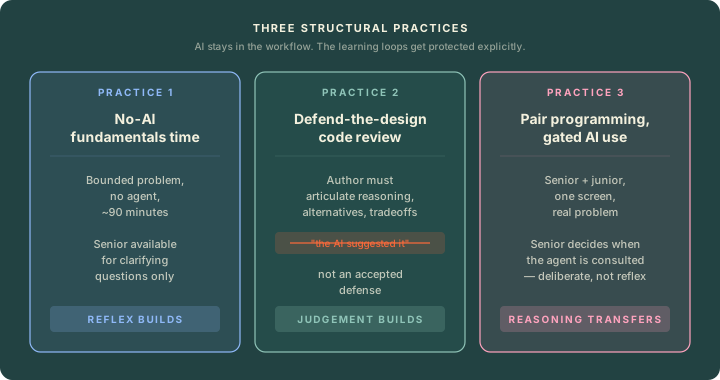
Figure 2: Three structural practices that preserve the learning loops without reducing AI usage in aggregate. The agent stays in the workflow; the moments where skill builds get protected explicitly.
What Engineering Leadership Should Do This Quarter
You do not need a policy overhaul. Four moves, sequenced over a quarter, that change the trajectory.
-
Measure the senior bench. For each team, count engineers at each level and the average time at level. If your team has been hiring juniors aggressively and the mid-level cohort has not moved in two years, you have the time bomb already. Most teams have not measured this.
-
Run one no-AI fundamentals session this week. Pick a small, well-scoped problem. Tell two juniors they have ninety minutes, no agent, senior available for clarifying questions only. Watch what happens. The first session is uncomfortable for everyone; it is also the most accurate read you will get on where the gap actually is.
-
Add the defend-the-design rule to your code review checklist. One question added to every PR template: "Why this approach and not the alternative?" Reviewers are instructed to push back when the answer cites the AI. Cheap to add, hard to game, durable in effect.
-
Re-instrument pair programming. Most teams stopped pairing during remote work and never restarted. Restart it specifically for junior-senior pairs, with the agent's role made explicit. One hour, twice a week, per junior. The senior's job is not to code — it is to model the reasoning the junior will need when the senior is no longer in the room.
The pattern is not new. Every prior generation of productivity tools — IDEs, debuggers, Stack Overflow, autocomplete — raised the same fear, and most of those fears turned out to be overblown. AI is different in degree, not in kind, but the degree matters. The proportion of cognitive work the tool absorbs is now high enough that the residual is not, by itself, enough to build a senior. The structures that build seniors have to be put back deliberately.
The Bottom Line
Your juniors are shipping more code than juniors did three years ago. They are learning less from each unit of code shipped. In the moment, the dashboards look great. Eighteen to twenty-four months from now, the team's senior bench will be thinner than expected, the mid-levels who were supposed to grow into seniors will plateau, and you will not be able to point to any specific decision that caused it.
The fix is not less AI. The fix is rebuilding the learning loops AI bypasses — no-AI fundamentals time, defend-the-design reviews, paired sessions with gated AI use — on purpose, every week, because the loops will not happen by accident anymore.
AI is making your junior engineers more productive. It is also making them worse at their jobs in ways the dashboards do not show. Which of those numbers does your team measure?


